
Working with a washboard player, I naturally played a lot of Kweskin Jug Band material — “Crazy Words, Crazy Tune,” “Borneo,” “Ukulele Lady,” “Beedle Um Bum,” “I’m Satisfied with My Gal”  (that was a call-and-response with Rob:
“She don’t wear no–”
“Yes, she does!”
“Oh, no, she don’t!”
“Oh, yes, she does!”), and a raft of others, among which this one (from a live recording at the Newport Folk Festival) was a favorite.
When we were playing in Harvard Square a fair number of passersby knew the Jug Band stuff — the Kweskin gang were local heroes and it had only been a dozen years since their heyday — so we often got requests and tried to be ready for them. In Torremolinos we didn’t have a lot of listeners who knew Kweskin’s repertoire specifically, but British skiffle fans were familiar with the style and enjoyed the good-time ragtime rowdiness.
At the time, I had only a vague sense of where the Kweskinites got their material — I knew about the Memphis Jug Band and Cannon’s Jug Stompers, and was aware that they were drawing on a lot of other sources, but in those days before the internet it was not easy to track those sources down. Honestly, I still have no idea where a lot of those songs came from — I’ve never heard anyone else do “Borneo” and the only people I’ve heard singing “Crazy Words, Crazy Tune” (a.k.a. “Washington at Valley Forge”) got it from Kweskin.
“Sadie Green, the Vamp of New Orleans” was in that category until I looked it up on the internet a couple of days ago and found 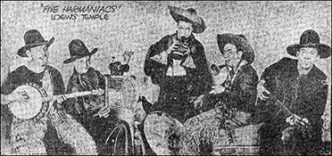 the Five Harmaniacs, whose 1926 recording was obviously the Kweskin band’s model. What had first attracted me to this particular song was Mel Lyman’s wailing, swinging harmonica break, which turns out to be directly based on the Harmaniacs’ intro, though I still think Lyman’s is better.
I wasn’t aware of the Harmaniacs, though a few of their recordings appeared on a jug band reissue LP in 1967, and my first assumption was that they were a white band imitating black groups like the Dixieland Jug Blowers and Memphis Jug Band. At some level, that may indeed be the case, but the tradition went a lot further back among both black and white players, and the Harmaniacs were one of the first bands to get it on record.
According to Dave Samuelson, who interviewed three group members:
 Dave noted that they hit right off with “Sadie Green” and went on to record for several labels, while a similar act in this period, Ezra Buzzington’s Rustic Revelers, went on to form the basis of the Hoosier Hot Shots, a very popular novelty band of the 1930s… yet another historical byway to be explored, though not, I think, by me. But I do enjoy playing the song.
 By the time I reached Málaga I was in love with Spain, so I got a cheap apartment and enrolled in language school. Rob took a detour north, hoping to run away to sea, returned a month later after sundry adventures that belong in his memoir, and we buckled down to learning Spanish and got a job playing every other night in a bar in Torremolinos. It was called Maggie’s Farm, owned by an American biker named Bernie who worked doing underwater demolition in the North Sea during the summer and had used his savings to buy the bar for his English wife, Maggie.
 That first winter, my attempts centered on a book with some basic flamenco rhythms, directions on how to play a rasgueado, and some simple semi-classical pieces, of which I retain only “Romance.”
 but there was this middle aged man sitting at the edge of the stage who sang along with both of them. It threw me off a bit, but I muddled through as best I could, and a bit later the middle-aged man got up with a fiddle, and turned out to be Tom Paley, of the New Lost City Ramblers…
 McGhee, of course, is best known as half of a long-time duo with Sonny Terry, which is fine as far as it goes, but obscures what a hip musician and songwriter he was. He and Sonny had a solid career as acoustic folk-blues artists, but he also did some great R&B sides, most famously working with his brother Stick McGhee on “Drinking Wine, Spo-dee-o-dee,” but also writing “Blues Had a Baby and They Named It Rock ‘n’ Roll” and a bunch of other songs, including this one. Dave changed it some, adding new lyrics on the turn-arounds, and it’s his version I still hear in my head, but he always credited it to Brownie, telling a long, funny story that is one more good reason to buy his final recording, …And the Tin Pan Bended, and the Story Ended.
 teenage boy. (I similarly acquired Stash Records’ Copulating Blues anthology, and their LPs of drug songs.) The Yazoo had a cover by R. Crumb that I found (and still find) offensive for all sorts of reasons, but which now apparently gets good prices on Ebay…
 Adam and Eve in the Garden of Eden surely must have shook that thing.
 His W.C. Fields imitation was legendary and I treasure his recordings of “Teddy Bear’s Picnic,” “I Want to Go Back to My Little Grass Shack in Kealakekua, Hawai’i,” Willie Nininger’s “I’m Proud to be a Moose” (which he adopted as a theme song in later years), and this song, which he first recorded with the Hudson Dusters and again on Sunday Street. I also heard him do this time and again at Passim Coffeehouse in Cambridge, because Bob Donlin, the owner, regularly requested it.
 The song was originally from Bing Crosby, though to this day I’ve never heard his version — in fact, strange as it seems, I’m not sure I’ve heard anyone sing it other than Dave. Crosby was one of Dave’s favorite singers, which surprised me the first time he mentioned it because I grew up in a world in which Crosby was regarded as distantly old and hopelessly square. Dave had grown up in an earlier era, and appreciated Crosby’s insouciance as well as his easy swing and smart phrasing — in the mostly forgotten jazz-world version of the Beatles/Stones split in which fans opted for either Crosby or Sinatra, Dave was thoroughly a Crosby man.
 — I don’t know where he’d heard it, and in those days before the internet I had no idea how to find sheet music or a recording of the verse, since all the books I found in stores or in the library had only the chorus.
 Canada. Brooks was also popular as a stage comedian, known for his imitation of Bert Williams, who reputedly saw him perform and commented, “If I’m as funny as that, I got nothing to worry about.” You can get a taste of his style from the one surviving film clip of him in performance, made in 1939, in which he sings a variation on the Strutters’ Ball theme, “
 by following the straight chorus with a
  She was from a fine old New England family, with what was known as a “swamp Yankee” accent, and had apparently contemplated running off to be a chanteuse in her youth — I have no idea what she sounded like then, but by 1977 she had many years of cigarettes behind her, and her voice had a soulful rasp that worked perfectly with this one.
 Clarence Williams, though his authorship has frequently been disputed, in particular by Louis Armstrong. Piron, who apparently copyrighted it in 1919 (though it wasn’t published till 1922), told Al Rose that Louis was kind of partly right, but…
 The etymology isn’t solid, but most authorities derive it from chemise — “shimmy” seems to have been American slang for a lightweight women’s blouse as early as the 1840s — and the dance move was to “shake your shimmy” by vibrating the relevant area as rapidly as possible.
 Indeed, this song became somewhat a bane of my existence in the 1970s, because whenever some musician or musicians who were roughly my age came by with mandolins, guitars, or something of that sort and asked if they could sit in (it happened rarely, but it happened), they were likely to ask if I knew “Hesitation Blues,” and then, inevitably, after maybe following up with “Winin’ Boy,” they’d want to play “Friend of the Devil…”
 I did a deep dive into the history of “Hesitation Blues” for my book on the censorship of early Black blues and jazz,
  the point being to keep adding and improvising verses until everyone ran out of ideas or got bored. Like a lot of dirty blues that were popular in oral tradition, it was cleaned up and published when blues caught on in the teens, with competing sheet music versions appearing in 1915 by W. C. Handy, the self-proclaimed “Father of the Blues,” and the white team of Scott Middleton and Billy Smythe. It seems to have first been
  white singer who had a close relationship with Handy, and then by various singers, both black and white, through the twenties and beyond, surviving as a rural standard.
 example the slender volume at right, written as Sheldon Lord, with its tempting tagline: “Anita was a virgin — till the hipsters got hold of her!”
 The model was “Engine 143,” which had been recorded by the Carter Family in 1927 and reissued on Harry Smith’s influential six-LP anthology, American Folk Music. You don’t have to know that to enjoy this song, but Block kept enough details from the original to make his lyric particularly amusing for the hardcore folk crowd, from the first line (“Along came the FFV, the swiftest on the line”) to the last (“And the very last words poor Georgie said was ‘Nearer My God, to Thee'”). The original song was a true story about a train wreck in 1890 and the death of the engineer, George Alley.
 and basically it sounded to me like pop-schlock.
 “Promised Land”), UNiversity 8-7748 (my parents’ number), or, in the case of Hawkshaw Hawkins’s number one country hit from 1963, the evocative LOnesome 7-7203.