
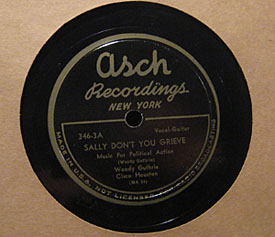
As I’m picking songs to include in this project, one criterion is if no one else seems to be doing them. This one clearly makes the cut on that basis, since as far as I can tell no one but Cisco and I has ever sung it. Also because it’s one of his few original compositions, apparently co-written with Lewis Allen, the pen name of Abel Meeropol,  who is better known for writing “Strange Fruit” and “The House I Live In.” When folk music became a pop commodity, first on the New York cabaret scene and then on the national hit parade, Meeropol was among the professional tunesmiths who tried his hand at writing pseudo-folk material such as Josh White’s “Apples, Peaches, and Cherries,” later a hit for Peggy Lee.
I had no idea Meeropol had a hand in this song, much less that it had been issued in sheet music with a mustache-less, matinee idol photo of Cisco on the cover, suggesting it was intended for the broader pop market. I thought it was just Cisco’s attempt to craft a feminist cowboy song, and learned it in that spirit, since I was growing up in a feminist household and there weren’t many cowboy songs tailored to that audience.

 Theodore Roosevelt. He went west in his teens, and by 1890 was a full-fledged cowboy, working as an “outside man,” which meant his job was to travel beyond the home ranch in search of cattle that had strayed into other herds. In the process, he was visiting all the other ranches and camps in southern New Mexico, and along the way he picked up a lot of songs — though he explains that most came it bits and pieces, a verse here and a verse there, and “many of the songs had to be dry-cleaned for unprintable words before they went to press.” He refers to this song as “The Educated Feller,” and writes, “It’s as typical of the range as ants in chuck wagon biscuits.
 were Woody Guthrie and Cisco Houston, and if I’d had to pick one of them, it would probably have been Cisco. Part of the appeal was the warmth of his voice and the easy lope of his guitar, but more than that it was the songs: he liked songs that told stories, and he had an actor’s gift for making those stories come alive.
 as well as writing a good book of cowboy songs and verse, Ten Thousand Goddam Cattle, and making a bunch of recordings, and just being a hell of a fascinating person. She’s still very much around at age 95, and it’s well worth checking out her website, www.katydoodit.com, and browsing through her interviews, and film clips, and book projects.
 “Talking Union” was the title song of the Almanac Singers’ most popular album (back in the days when “album” meant literally that: a bound album of 78 records). As I mentioned in the last couple of posts, my first records included a bunch of left-wing 78 albums, including Talking Union, though that one was missing its cover and I only learned what it looked like about forty years later.
 I helped form a steering committee when we put together the Boston Globe Freelancers Association under the auspices of the National Writers Union and led a walk-out of three hundred freelance writers, photographers, and designers who refused to sign a new and confiscatory contract. I was sorry to go, because I liked writing for the Globe, but I figured that after thirty years of singing union songs it was time to step up and be counted.
 It was on the one Almanac Singers’ album my grandparents had, which I eventually learned was called Talking Union — I didn’t know the title at the time because the cover had fallen off before it came into my hands.
 Many years later, when I was researching my
 6, 33 1/3, 45, and 78. They wouldn’t let me play their records on it, but I had a few children’s folk LPs — one by Tom Glazer, and a couple of Everybody Sing! anthologies — and somehow I also ended up with my grandparents’ 78 albums.
 but along with dozens of classical albums, they had the classic Communist record collection of the early 1940s: Paul Robeson, the Red Army Chorus, the International Brigades from the Spanish Civil War, Josh White, the Almanac Singers, and the Union Boys. The Union Boys wasn’t actually a group — it was just a bunch of singers who got together to record an album’s worth of songs about union organizing and the war effort, among them Pete Seeger, Burl Ives, Tom Glazer, Josh White, Brownie McGhee and Sonny Terry, plus one side by Woody Guthrie and Cisco Houston.
 I played those records constantly and learned most of the songs, and these two were particular favorites. I suppose part of the appeal was the war — despite my parents’ pacifist leanings, I played with toy soldiers and dug trenches and all that kind of stuff, and it was exciting to sing about rolling into Berlin with your buddies from the union and going after Hitler. I didn’t understand all the words, of course — I don’t think I knew the meaning of either UAW or CIO — but thirty years later, when I helped organize a freelancer’s group at the Boston Globe under the auspices of the National Writers Union, I was particularly pleased that we were a subsection of the UAW. It kind of brought everything full circle, and felt like I’d stayed true to my early friends.
 The title song was his own composition–he was always trying to come up with new approaches to old blues styles, and this is a perfect example: the humor and language are a mix of his modern sensibility and the kind of street lingo he enjoyed in songs and books from earlier eras, in keeping with the tastes of a man who named his rock band the Hudson Dusters after one of the Irish street gangs in Herbert Asbury’s Gangs of New York. For example, to be in tap city is an extension of “tapping out,” or going broke at poker.
 so I settled for playing a couple of Johnson’s pieces, with some licks from Son House, who seems to have been the main source for his slide style, and this is the one that stuck with me.
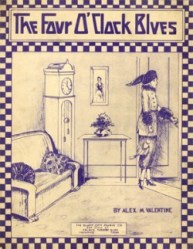 Which said, Dunn’s recording is an instrumental, and the published sheet music has lyrics that bear no resemblance to what Johnson sang… and the song was also published in Memphis around that time with credit to another composer, Alex Valentine… and Skip James recorded a version of the song as “Four O’Clock Blues,” before Johnson did it, with yet another set of lyrics… and Alan Lomax recorded yet another version of the song in 1941 from Son House, Willie Brown, and Fiddlin’ Joe Martin, who could have been Johnson’s source…