
This may well have been the first old pop song I worked out for myself on guitar, and I played it regularly on the street in Harvard Square with Rob Forbes on washboard. Indeed, it was Rob who taught me the verse and helped me work out the chords to it, following the melody he recalled — I don’t know where he’d heard it, and in those days before the internet I had no idea how to find sheet music or a recording of the verse, since all the books I found in stores or in the library had only the chorus.
“Darktown Strutters’ Ball” was one of the biggest hits of the teens, published in 1917 and composed by Shelton Brooks, who had hit back in 1909 with “You Ain’t Talking to Me,” followed in 1911 by the wildly popular “Some of These Days,” then “I Wonder Where My Easy Rider’s Gone” and the dance craze hit “Walkin’ the Dog.” Brooks went on to have a fairly successful recording career in the 1920s, starting with “The Darktown Court Room,” but is little remembered today in that context because on records he was primarily a “monologuist” (what we’d now call a comedian) rather than a singer, and his monologues tended to be in exaggerated blackface minstrel dialect — an even more distant affectation than usual for an African American performer, since he was born and grew up in Ontario, Canada. Brooks was also popular as a stage comedian, known for his imitation of Bert Williams, who reputedly saw him perform and commented, “If I’m as funny as that, I got nothing to worry about.” You can get a taste of his style from the one surviving film clip of him in performance, made in 1939, in which he sings a variation on the Strutters’ Ball theme, “Hole in the Wall.”
According to some reports, “Darktown Strutters” was inspired by an annual ball in Chicago that was kind of a modern equivalent of the medieval carnivals of misrule, financed by wealthy society folk but with a guest list of pimps and prostitutes. On the other hand, Brooks told Ian Whitcomb that he wrote the song after hearing a story about an ordinary working stiff who got “an invitation to an affair to be given by the local pimps. A big ball. All a mistake and he should never have been asked.” As far as I can find, this event was not called the Darktown Strutters’ Ball, but I guess that seemed like a more marketable title than “Pimps and Hookers Ball.”
Howard Armstrong, with whom I played this song for several years in the 1990s, took it back to its roots by following the straight chorus with a truly filthy parody — though he did not tend to perform that version onstage. If you care to check it out, be warned: the language is as raw as can be, an apt reminder of all the folklore of the jazz and blues world that never got recorded due to prudery, and hence the mistaken impression that modern gangsta rappers use nastier language than their great-grandparents used in the 1920s.
I haven’t performed this song in decades because it feels weird — at best — to be a white guy singing about going to the “Darktown” ball… for a while I tried changing the lyric to “Uptown Strutters Ball,” but that felt differently weird, since it’s a well-known song and that’s the title phrase. The odd thing is that in all the years I sang this on the street and sometimes in clubs, no one ever suggested it might be in any way offensive to anybody, or that I might want to think about what I was singing… which just shows how white my audiences have tended to be and what an amazingly sheltered life white people tend to lead in this great land of ours.
 She was from a fine old New England family, with what was known as a “swamp Yankee” accent, and had apparently contemplated running off to be a chanteuse in her youth — I have no idea what she sounded like then, but by 1977 she had many years of cigarettes behind her, and her voice had a soulful rasp that worked perfectly with this one.
 Clarence Williams, though his authorship has frequently been disputed, in particular by Louis Armstrong. Piron, who apparently copyrighted it in 1919 (though it wasn’t published till 1922), told Al Rose that Louis was kind of partly right, but…
 The etymology isn’t solid, but most authorities derive it from chemise — “shimmy” seems to have been American slang for a lightweight women’s blouse as early as the 1840s — and the dance move was to “shake your shimmy” by vibrating the relevant area as rapidly as possible.
 Indeed, this song became somewhat a bane of my existence in the 1970s, because whenever some musician or musicians who were roughly my age came by with mandolins, guitars, or something of that sort and asked if they could sit in (it happened rarely, but it happened), they were likely to ask if I knew “Hesitation Blues,” and then, inevitably, after maybe following up with “Winin’ Boy,” they’d want to play “Friend of the Devil…”
 I did a deep dive into the history of “Hesitation Blues” for my book on the censorship of early Black blues and jazz,
  the point being to keep adding and improvising verses until everyone ran out of ideas or got bored. Like a lot of dirty blues that were popular in oral tradition, it was cleaned up and published when blues caught on in the teens, with competing sheet music versions appearing in 1915 by W. C. Handy, the self-proclaimed “Father of the Blues,” and the white team of Scott Middleton and Billy Smythe. It seems to have first been
  white singer who had a close relationship with Handy, and then by various singers, both black and white, through the twenties and beyond, surviving as a rural standard.
 example the slender volume at right, written as Sheldon Lord, with its tempting tagline: “Anita was a virgin — till the hipsters got hold of her!”
 The model was “Engine 143,” which had been recorded by the Carter Family in 1927 and reissued on Harry Smith’s influential six-LP anthology, American Folk Music. You don’t have to know that to enjoy this song, but Block kept enough details from the original to make his lyric particularly amusing for the hardcore folk crowd, from the first line (“Along came the FFV, the swiftest on the line”) to the last (“And the very last words poor Georgie said was ‘Nearer My God, to Thee'”). The original song was a true story about a train wreck in 1890 and the death of the engineer, George Alley.
 and basically it sounded to me like pop-schlock.
 “Promised Land”), UNiversity 8-7748 (my parents’ number), or, in the case of Hawkshaw Hawkins’s number one country hit from 1963, the evocative LOnesome 7-7203.
 and it had even become a matter of principle for me. I felt like a lot of the blues revivalists I liked had started out with Woody, Cisco, and Pete Seeger, but abandoned that music when they got into blues, and I understood the temptation but didn’t want to give in to it.
 had a similarly broad repertoire and similar experience playing a wide range of regional blues and dance tunes.
 is from a session he did for the embryonic Atlantic Records in 1949, well before it became a powerhouse jazz and R&B label. In a long
  We went to the studio that same day, but he only wanted to play gospel songs. I said, “Oh, man, but we wanted some blues.” He said, “Well, I don’t sing blues anymore, I’ve found God.” I said, “But you make great blues music – this is not a bad thing – if you could just sing some blues.” “Well,” he said, “don’t put my name on it.” So I said, “OK, we’ll call you Barrelhouse Sammy.” So we made some blues records and they came out under that name until after he died, when we released them with his actual name. It would have been criminal not to let people know who he was.
 guitar on most of his records, which meant I could never get his sound, and tuned it very low, which made it hard for me to pick up licks in those days before we had digital pitch-shifting.
 was Blues at Newport, and I put on this song, then played it for my mother, and we went to the concert, and that was that.
 I’ve made some minor changes as well, and picked up other bits here and there, but this is substantially Dave’s version, with the Blake guitar roll from that guy in Harvard Square.
 (There’s
 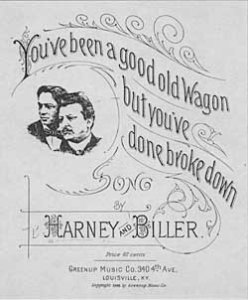 For one, it was one of the handful of songs recorded by Ben Harney, one of the first ragtime composers. For another, it is a version of Harney’s first hit and one of the first published ragtime compositions, from 1895, which was titled “You’ve Been a Good Old Wagon But You’ve Done Broke Down…” a familiar title to Van Ronk fans although, aside from the title line, which presumably inspired the