
This was the one Van Ronk original on Dave’s first album, and another song I’d brought to Europe on cassette. I don’t remember where I took the time to figure out the guitar part, but in my memory it is forever linked to my first performance at a rock festival. (Which was also my last, but why mention that?)
I was hitchhiking out of Salzburg, Austria, and it was getting late when a van pulled over and a bunch of long-haired guys said they weren’t going far, but if I needed a place to sleep I could come with them. They were members of a rock band, headed for a house in the country where they all lived together. Of course I said yes, and we spent the evening playing music, and it turned out they were having a rock festival on their land in a couple of weeks and offered me a spot on it. So I traveled around a bit, came back to their place, and did the gig.
There was nothing particularly memorable about the festival itself — aside from the moment when I went into the house to use the bathroom and interrupted the guitarist’s lovely lady friend shooting up — but the headliner was a Scottish singer and guitarist named Les Brown, who was living in Austria at the time. He was a fair blues fingerpicker and knew Van Ronk’s repertoire, so we hit it off and he took it upon himself to give me some tips on playing around northern Europe.
His two main tips were that there was lots of work in Germany and I shouldn’t take a gig for under 200 Deutschmarks (about a hundred dollars). That sounded like a lot to me, but I headed west and spent a month or so wandering from Tübingen up to Münster, and booked a half-dozen gigs for a couple of months in the future — my first tour of anyplace, ever. At that point American folk-blues guitarists were an easy sell in Germany: I’d just walk into a club with my guitar case, say I wanted to book a gig, and they’d book me. Not a single manager asked to hear me before giving me the job.
It was also very easy to find places to sleep — if I was playing on the street I’d put a sign on my guitar case saying I needed a bed for the night, or if I didn’t feel like playing I could go into a pub that catered to young people and ask the bartender for advice. I remember one giving me the address of a student commune, and I went over and rang the bell, and a young woman opened the door, stark naked. I explained what I wanted, and she took me to a big room with several mattresses on the floor and pointed out which one I could have for the night. It was like that in the 1970s. (And no, I didn’t sleep with her. She was on another mattress, and we both were there to sleep.)
There are plenty of other memories of that month or so — a run-in with the cops while sleeping in a park in Dusseldorf, for example — but to finish up for the moment, I had the good fortune to wangle a guest set followed by a gig at the legendary Folkclub Witten, the oldest folk club in that part of Germany (maybe in all of Germany), run by a force of nature named Hildegard Doebner. I don’t remember much about the gigs, but she was wonderful, and when I later met and worked for Lena Spencer at the Caffe Lena in Saratoga Springs, I was instantly reminded of Hildegard.
One other thing: Les performed a song at the Austrian rock fest that has stuck with me ever since, and I just hunted it up on the internet and present it for your delectation. He wrote out the words and recommended learning it for the US soldier bars, and I didn’t want to do that circuit, so never learned it completely, but I got the chorus just by hearing Les sing it through. It turns out to have been recorded in 1961 by a Germany-based country singer named Eddie Wilson, and the chorus went:
Dankeschön, Bitteschön, Wiedersehn,
Noch ein Bier, kommen sie Hier.
Grosser und kleiner und nicht verstehn,
I wish I could sprechen sie Deutsch.
None of which has anything to do with “If You Leave Me, Pretty Mama,” a lovely example of Dave Van Ronk’s early style, except that I played it that afternoon for Les and remembering it triggered the chain of memories.
 this Fred Neil composition was one of the three songs Judy Roderick sang on a Newport Folk Festival collection, backed by John Hammond on harmonica. I loved her version, included it on my homemade cassette of contemporary folk songs, and had just figured out how to play it during the few days I spent in Annecy.
 Grosseto and inland to Gabellino, the smallest town I’ve ever seen on a map. It was only on the map because it had been a way-station for travelers between the coast and Siena since the middle ages, and it was still just one building, an inn with a few bedrooms and a restaurant.
 Someone pointed me in the right direction and I walked up to her house and she was out back feeding the chickens. A while later we were sitting on a grassy hillside with a bottle of local wine and I was playing songs for her. This was one of them and she particularly liked it, and since I never played it much after that, it always reminds me of that afternoon.
 I spent working on this one, in a small bedroom in Annecy, France. I’d spent a month there when I was sixteen as part of an exchange program — I’ve written about part of that trip in my post on “
 has anything to do with Joseph Spence or “Glory of Love,” but it’s etched in my memory because I had never attempted to learn anything like this off a recording before, and I found that I could actually do it. It wasn’t perfect, and I’ve added a lot of Spencifications since that I didn’t get on that first pass, but it was a breakthrough and started me off on one of my favorite musical journeys.
 immediately asked if I knew
  the distinction at that point) blues guitarist, Oscar Klein — I would have said because he was more soulful, and I still think that’s true, but also because he was playing like Lightnin’ Hopkins, not exploring or expanding a new, European take on blues, so I was more familiar with what I was hearing. He was a jazz trumpet player and had a great feel on guitar, and he didn’t try to sing, which also helped.
 was singing in German, but had written a thoroughly German, thoroughly modern lyric to the Gary Davis/
 As with “
 in his quest to present American song in all its raw majesty, “a volume full of gargoyles and gnomes, a terribly tragic book and one grinningly comic…”
 (that was a call-and-response with Rob:
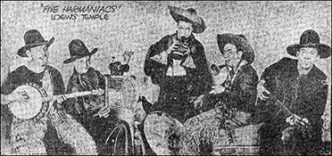 the Five Harmaniacs, whose 1926 recording was obviously the Kweskin band’s model. What had first attracted me to this particular song was Mel Lyman’s wailing, swinging harmonica break, which turns out to be directly based on the Harmaniacs’ intro, though I still think Lyman’s is better.
 Dave noted that they hit right off with “Sadie Green” and went on to record for several labels, while a similar act in this period, Ezra Buzzington’s Rustic Revelers, went on to form the basis of the Hoosier Hot Shots, a very popular novelty band of the 1930s… yet another historical byway to be explored, though not, I think, by me. But I do enjoy playing the song.
 By the time I reached Málaga I was in love with Spain, so I got a cheap apartment and enrolled in language school. Rob took a detour north, hoping to run away to sea, returned a month later after sundry adventures that belong in his memoir, and we buckled down to learning Spanish and got a job playing every other night in a bar in Torremolinos. It was called Maggie’s Farm, owned by an American biker named Bernie who worked doing underwater demolition in the North Sea during the summer and had used his savings to buy the bar for his English wife, Maggie.
 That first winter, my attempts centered on a book with some basic flamenco rhythms, directions on how to play a rasgueado, and some simple semi-classical pieces, of which I retain only “Romance.”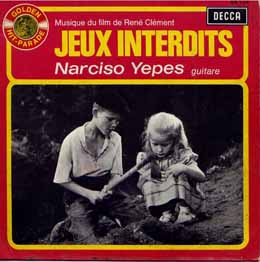
 but there was this middle aged man sitting at the edge of the stage who sang along with both of them. It threw me off a bit, but I muddled through as best I could, and a bit later the middle-aged man got up with a fiddle, and turned out to be Tom Paley, of the New Lost City Ramblers…
 McGhee, of course, is best known as half of a long-time duo with Sonny Terry, which is fine as far as it goes, but obscures what a hip musician and songwriter he was. He and Sonny had a solid career as acoustic folk-blues artists, but he also did some great R&B sides, most famously working with his brother Stick McGhee on “Drinking Wine, Spo-dee-o-dee,” but also writing “Blues Had a Baby and They Named It Rock ‘n’ Roll” and a bunch of other songs, including this one. Dave changed it some, adding new lyrics on the turn-arounds, and it’s his version I still hear in my head, but he always credited it to Brownie, telling a long, funny story that is one more good reason to buy his final recording, …And the Tin Pan Bended, and the Story Ended.
 teenage boy. (I similarly acquired Stash Records’ Copulating Blues anthology, and their LPs of drug songs.) The Yazoo had a cover by R. Crumb that I found (and still find) offensive for all sorts of reasons, but which now apparently gets good prices on Ebay…
 Adam and Eve in the Garden of Eden surely must have shook that thing.
 His W.C. Fields imitation was legendary and I treasure his recordings of “Teddy Bear’s Picnic,” “I Want to Go Back to My Little Grass Shack in Kealakekua, Hawai’i,” Willie Nininger’s “I’m Proud to be a Moose” (which he adopted as a theme song in later years), and this song, which he first recorded with the Hudson Dusters and again on Sunday Street. I also heard him do this time and again at Passim Coffeehouse in Cambridge, because Bob Donlin, the owner, regularly requested it.
 The song was originally from Bing Crosby, though to this day I’ve never heard his version — in fact, strange as it seems, I’m not sure I’ve heard anyone sing it other than Dave. Crosby was one of Dave’s favorite singers, which surprised me the first time he mentioned it because I grew up in a world in which Crosby was regarded as distantly old and hopelessly square. Dave had grown up in an earlier era, and appreciated Crosby’s insouciance as well as his easy swing and smart phrasing — in the mostly forgotten jazz-world version of the Beatles/Stones split in which fans opted for either Crosby or Sinatra, Dave was thoroughly a Crosby man.