
This is another song I learned in Lubumbashi, Zaire (now the Democratic Republic of Congo), when I was there in 1990 to study guitar with Jean-Bosco Mwenda. I’ve already posted a bunch of songs I learned from Bosco (“Masanga,” “Kijana Muke,” “Bibi Theresa,” and “Kuolewa“), and this is another — but I learned this one from his cousin, Edouard Masengo.
 I wrote about Masengo in a previous post, with his song “Lwa Kiyeke.” He was a lovely singer and a sweet man, though down on his luck by the 1990s, and he should be better known. Bosco has become the only name most people know from the Congolese acoustic scene of the late 1950s and 1960s, even if they are pretty deep into African guitar, but he was one of three terrific and widely recorded artists, along with Masengo — who likewise had a second career in Kenya — and Losta Abelo, who died the year before I got there.
The guitar part for this song is similar to “Bibi Theresa,” so I added a lick from that arrangement. The lyric confused me for a while. It translates as:
Victorina, Victorina, my love,
My father told me, “You will marry Victorina.”
Albertina, Albertina, my love,
My father told me, “You won’t marry Albertina.”
Victorina, Victorina, I am lying in bed,
My soul and my thoughts are of Victorina.
Albertina, Albertina, my love,
My father told me, “You won’t marry Albertina.”
Having been raised in the Euro-American romantic tradition, I was baffled by this, because in all our standard romances, if a young man has to choose between two women and his father tells him he must marry one of them and not the other, the natural course of the story is for him to realize he truly loves the one his father has forbidden — so why was this guy lying in bed dreaming of the woman his father said he should marry?
I eventually called my friend Dominic Kakolobango, whom I’ve written about in previous posts (we shared his tiny room in Lubumbashi, and I recommend his videos and recordings, as well as  this duet version we did of “Malaika“) and asked him to explain what was going on in this song. It took a while for him to figure out what was confusing me, but then he explained that in his culture it was normal to respect and trust one’s father’s advice, and to marry the woman he recommended.
My favorite performance of this was during my journey from Lubumbashi to Burundi — I don’t remember my route, but it started with catching a ride in a jeep taking the wife of a local Peace Corps manager for two days, then hitchhiking to someplace on Lake Tanganyika, where I caught a ferry for Bujumbura… but between the jeep and the hitchhiking, I stopped off to visit a Peace Corps volunteer who was living in a small village on the banks of the Congo River. That involved walking along some railroad tracks for about ten miles, then down a dirt road for a few miles, then continuing along a path through the forest for another few miles — I have no recollection of how I found my way — and the village had no electricity or plumbing, or much of anything. The food was basically bukari (like Kenyan fufu) made from cassava flour, flavored with cassava leaves, and sometimes some tiny fish the locals boiled into a sort of mush. Fortunately, they also distilled a pretty decent hard alcohol. Anyway, there wasn’t much in the way of entertainment, so everyone was very glad when I showed up with a guitar, and the whole population shortly gathered for a concert. As often happened, they were not much interested in my US repertoire, so I ran through all my Congolese songs, and this was the big hit, because the village leader’s wife was named Albertina.
So there it is. I’ve posted Masengo’s version, which he just called “Victorina,” on Soundcloud. I’ve also posted a nice interview with Masengo from a Kenyan cassette, and a couple of his songs, including his tribute to Losta Abelo. Bosco’s version of this song was called “Victoria Mpenzi” (he sang the name Victorina, so I’m guessing the record company got it wrong, or maybe the person who labeled my tape) and I’ve never heard a clean copy of the 78, so if anyone finds one, please let me know.
 up with Billy Novick for lessons, and Billy sent her to the Concord Inn, to hear Jimmy Mazzy and his gang — which led to a year or so of her playing with them every week (and with me, in between).
 He also played wonderful, idiosyncratic banjo, and sang with a wry tunefulness that captured the humor and sentiment of lyrics that I might otherwise have considered throw-aways.
 Anyway, that was my introduction to Los Tigres, and before I left Mexico I bought an LP of their greatest hits and a Guitarra fácil booklet with lyrics and chords to a bunch of their songs, along with LPs and booklets of Los Bravos del Norte, Los Cadetes de Linares, and some other norteño groups, and an LP of Los Teen Tops, who did “Rock de la cárcel.”
 I’ve enjoyed playing ranchera songs — an earlier post has my version of “
 The song was originally recorded by a mariachi singer named Joe Flores, but the Tigres’ version was definitive and made them into international stars, as well as spawning a string of low-budget action movies: first Contrabando y traición, then Mataron a Camelia, El hijo de Camelia, Emilio Varela vs. Camelia la texana… and who knows how many more. Los Tigres also made almost twenty movies, some of which are pretty interesting — for example La jaula de oro, about the tribulations of an undocumented Mexican immigrant raising a family in California.
 This is kind of a ringer, since I haven’t filmed a live video to go with it, but “West Texas Waltz” was the only song I ever performed on diatonic accordion, which kind of required a band, and for a moment I had the band… so I’m posting that version. I recorded it for my Street Corner Cowboy cassette, with my regular partners Washtub Robbie Phillips on one-string wombat bass, Peter Keane
 on guitar and “yee-hah,” and — for this project only, because he was recording and co-producing, Orrin Starr on mandolin. The photo in the video is from my only live show with that line-up, the cassette release party at Club Passim, which also included Mark Earley and Cormac McCarthy. A good bunch, and I get nostalgic listening to this.
 My teacher was Geert van den Elsacker, a terrific musician and composer with a deep knowledge of traditional Flemish accordion styles — his main instrument, pictured on this lesson book, was the two-row diatonic — and French musette, which he played on a chromatic button instrument that looked fiendishly complicated, and when I was studying with him he was in the process of learning to play bandoneon and the Argentine tango repertoire. It was an education just being around him, and he was very patient with me — and I wish I could steer you towards his own performances, but he was tragically killed a year or so later in a stupid accident, hit by a car while bicycling through town.
 Hamilton defended a German immigrant printer named John Peter Zenger who was accused of printing several “low ballads” in his New York Weekly Journal, which, it was charged, contained “many things tending to sedition and faction, and to bring his Majesty’s government into contempt, and to disturb the peace thereof.” The judge did not accept the argument that the ballads were justifiable if they could not be proved false, and ordered the jury to convict, but Hamilton’s eloquence persuaded them otherwise and Zenger was acquitted — thus establishing a right to freedom of the press which was later codified in the US Constitution.
 and developing an enduring affection for horses and blue jeans. When he got back east, he wore jeans for the wedding, which was performed by the postmaster of Durham, New Hampshire.
 and quirky player that most of my efforts just sounded like half-assed imitations of what he happened to play on a given day. I’ve kept playing his “
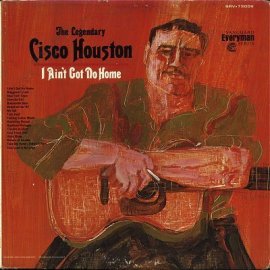 The point of that digression is that when I started messing around with Jefferson’s music, this one had that extra connection, and when I figured out I couldn’t do it like he did, I could fall back on what I’d picked up from Cisco and Woody. So that’s kind of what I’ve done. I think the lyric I sing is mostly Jefferson’s, and the guitar part is based on his, with some licks borrowed from Sam McGee’s “
 often marked time between verses with a kind of boom-chang strum that comes from the same place as Woody’s style, and Woody played lots of blues. Not to mention the verse about robbing trains like Jesse James, an outlaw hero they all sang about.
 Sam Eskin, a self-educated folklorist and singer who was born in 1898 and began traveling around in the 1940s, recording singers all over the US and Mexico. I can’t say for sure where Eskin got this, but a likely source was David McIntosh, an Illinois folklorist who began working in the Ozarks in the 1930s and sang a virtually identical version at the National Folk Festival in 1937, which he apparently had collected from a Mr. Jones who lived south of Carbondale. (I have put
  Bill mostly sang his own songs, but back in the early 1980s he also had some older songs he performed pretty regularly, and I was blown away by the way he dug into this lyric and made it come alive — I can still picture him onstage at the Nameless Coffeehouse in Cambridge, and see exactly the expression on his face as he sang, “I got so goddamn hungry, I could hide behind a straw.” He was acting as much as singing: a raw, skinny outlaw staking his final, wry testament.
 I didn’t know any of that until I began working on this post; I just liked the song and played it more or less like Dave and Bill did, but I rarely performed it became my versions always seemed to drag. Then it was featured in Inside Llewyn Davis, and a whole bunch of new people did it, and my version felt even more superfluous, so I decided to leave it out of the Songobiography… until a few months ago it occurred to me that I could play it more like Buell Kazee would have done it, with the guitar keeping a quick banjo rhythm and the vocal line expanding and contracting to fit the mood of the lyric.
 1960 on a Life magazine set of Western songs featuring him and Rosemary Clooney, but Sam Hinton was also on that set, so could easily have been Crosby’s source. Dave was a big fan of Crosby’s jazz singing and I’d love to think Dave got the song from his recording, but Crosby left out the “Got so goddamn hungry” verse, so there must have been another intermediary. (Which said, I still kind of love the fact that Crosby seems to have made the first issued recording of this variant.)
 Stole My Gal” and over a dozen other songs. I learned this by ear off a Kweskin album, years before my ears were up to the task, and only realized how far off I was when I had the opportunity to open a concert for Guy Van Duser and Billy Novick and Billy very kindly offered to play clarinet on one of my songs. I suggested this one, we tried to run through it, and he informed me that I had the chords completely wrong. I think he may even have tried to learn my version, because he’s a really nice guy, but it was a complete mess, so we did something else.
 book from the old days, illegally printed for cocktail lounge pianists , with 1,000 popular songs, three to a page, and no royalties paid to the songwriters or publishers. By that time, though, I wasn’t playing a lot of old pop tunes, so the song kind of languished in the hinterlands of my memory until I had the good fortune to marry Sandrine Sheon and she decided to pick up the clarinet she had played back in high school, and suddenly I needed a repertoire of early jazz and swing.
 As for “All of Me,” I have no idea where or when I first heard it, or from whom. I know I had learned it by the mid-1970s and enjoyed playing it in appropriate circumstances, but I tended not to perform it onstage because it was also one of the tunes everyone else had learned and enjoyed playing, and there were plenty of less familiar standards to choose from. However… one day Sandrine and I were fooling around with “Somebody Stole My Gal,” and after a few choruses I felt like shifting to another song, and it occurred to me that the narrative could lead into “All of Me,” putting a new twist on the lyric. So here it is, or they are.
 couple of other bands and gave me Fadhili William’s phone number in the United States, explaining that William had moved there some years earlier, pursuing royalties for his world-famous song, “Malaika,” and was currently working in a gas station in New Jersey.
 When I left school in 1959, that’s the time I composed “Malaika.” When I was in school I had a girlfriend, to me she looked like an angel. Her name was Fanny, but I nicknamed her Malaika. I wanted to get married to her, but you had to pay dowry to get married and I didn’t have that kind of money. So she was married by somebody else who had the dowry, the parents. Now, the only thing I could make her remember me is by playing that song. Even though there was her husband at home, listening to the radio, she could hear that song, because she knows her nickname, and the husband won’t know who is this Malaika, to portray that message to her that I still love her.
 in Antwerp in the summer of 1979, staying with a guy named Marc who played terrific guitar using just his thumb and middle finger — I have no idea why he didn’t use his index finger, but he didn’t — and he had Doc Watson’s recording and I learned a half-assed version of it.
 The only other Loudermilk composition I ever learned is a teen novelty song “Norman,” which was a hit for Sue Thompson in 1961 (which I see is also when Atkins recorded W&W). I probably learned “Norman” as a joke when I was in my teens, and almost fifty years later I’m still stuck with it: