
I love Lemon Jefferson’s singing and playing, and for a while immersed myself in his guitar style, but he was such a distinctive  and quirky player that most of my efforts just sounded like half-assed imitations of what he happened to play on a given day. I’ve kept playing his “Black Horse Blues,” since it is a fully composed arrangement, and used his “Bad Luck Blues” arrangement for my version of “Keep It Clean” — but otherwise I’ve let well enough alone…
…except for this one, which is a special case, because I originally learned it as a Woody Guthrie song. He called it “New York Town,” and I had it on a Cisco Houston LP — as noted in earlier posts, Cisco was my first musical hero, and I played dozens of songs from his records. At some point I got the idea that Woody got this song from Lead Belly, which seems very possible, and then, probably quite a few years later, realized that all of them got it from Jefferson.
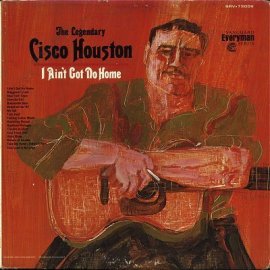 The point of that digression is that when I started messing around with Jefferson’s music, this one had that extra connection, and when I figured out I couldn’t do it like he did, I could fall back on what I’d picked up from Cisco and Woody. So that’s kind of what I’ve done. I think the lyric I sing is mostly Jefferson’s, and the guitar part is based on his, with some licks borrowed from Sam McGee’s “Railroad Blues,” and a bit of Mississippi John Hurt. And, honestly, aside from the final verse, I’m not aware of anything specific that came from my earlier heroes…
…except that having first learned it from Cisco, as a Woody Guthrie song, I was used to singing it as a cowboy/western song rather than as a blues, or maybe it makes more sense to say I sang it as a cowboy/western blues, since there were plenty of Black cowboys and Lead Belly sang Western ballads as well as blues, and Jefferson  often marked time between verses with a kind of boom-chang strum that comes from the same place as Woody’s style, and Woody played lots of blues. Not to mention the verse about robbing trains like Jesse James, an outlaw hero they all sang about.
That’s a good example of how mixed up and multifarious the US folk tradition is, and the funny thing is that I learned this long before I was playing any blues, never thought of it as blues, and dropped it from my repertoire when I got into blues… and then I had that Jefferson period, which was fun and challenging but mostly left no trace on my repertoire… except to send me back to Cisco and Woody. Which is fine, and I snuck in a couple of Jefferson’s guitar licks, and the result feels like a nice summation of that journey.
 Sam Eskin, a self-educated folklorist and singer who was born in 1898 and began traveling around in the 1940s, recording singers all over the US and Mexico. I can’t say for sure where Eskin got this, but a likely source was David McIntosh, an Illinois folklorist who began working in the Ozarks in the 1930s and sang a virtually identical version at the National Folk Festival in 1937, which he apparently had collected from a Mr. Jones who lived south of Carbondale. (I have put
  Bill mostly sang his own songs, but back in the early 1980s he also had some older songs he performed pretty regularly, and I was blown away by the way he dug into this lyric and made it come alive — I can still picture him onstage at the Nameless Coffeehouse in Cambridge, and see exactly the expression on his face as he sang, “I got so goddamn hungry, I could hide behind a straw.” He was acting as much as singing: a raw, skinny outlaw staking his final, wry testament.
 I didn’t know any of that until I began working on this post; I just liked the song and played it more or less like Dave and Bill did, but I rarely performed it became my versions always seemed to drag. Then it was featured in Inside Llewyn Davis, and a whole bunch of new people did it, and my version felt even more superfluous, so I decided to leave it out of the Songobiography… until a few months ago it occurred to me that I could play it more like Buell Kazee would have done it, with the guitar keeping a quick banjo rhythm and the vocal line expanding and contracting to fit the mood of the lyric.
 1960 on a Life magazine set of Western songs featuring him and Rosemary Clooney, but Sam Hinton was also on that set, so could easily have been Crosby’s source. Dave was a big fan of Crosby’s jazz singing and I’d love to think Dave got the song from his recording, but Crosby left out the “Got so goddamn hungry” verse, so there must have been another intermediary. (Which said, I still kind of love the fact that Crosby seems to have made the first issued recording of this variant.)
 Stole My Gal” and over a dozen other songs. I learned this by ear off a Kweskin album, years before my ears were up to the task, and only realized how far off I was when I had the opportunity to open a concert for Guy Van Duser and Billy Novick and Billy very kindly offered to play clarinet on one of my songs. I suggested this one, we tried to run through it, and he informed me that I had the chords completely wrong. I think he may even have tried to learn my version, because he’s a really nice guy, but it was a complete mess, so we did something else.
 book from the old days, illegally printed for cocktail lounge pianists , with 1,000 popular songs, three to a page, and no royalties paid to the songwriters or publishers. By that time, though, I wasn’t playing a lot of old pop tunes, so the song kind of languished in the hinterlands of my memory until I had the good fortune to marry Sandrine Sheon and she decided to pick up the clarinet she had played back in high school, and suddenly I needed a repertoire of early jazz and swing.
 As for “All of Me,” I have no idea where or when I first heard it, or from whom. I know I had learned it by the mid-1970s and enjoyed playing it in appropriate circumstances, but I tended not to perform it onstage because it was also one of the tunes everyone else had learned and enjoyed playing, and there were plenty of less familiar standards to choose from. However… one day Sandrine and I were fooling around with “Somebody Stole My Gal,” and after a few choruses I felt like shifting to another song, and it occurred to me that the narrative could lead into “All of Me,” putting a new twist on the lyric. So here it is, or they are.
 couple of other bands and gave me Fadhili William’s phone number in the United States, explaining that William had moved there some years earlier, pursuing royalties for his world-famous song, “Malaika,” and was currently working in a gas station in New Jersey.
 When I left school in 1959, that’s the time I composed “Malaika.” When I was in school I had a girlfriend, to me she looked like an angel. Her name was Fanny, but I nicknamed her Malaika. I wanted to get married to her, but you had to pay dowry to get married and I didn’t have that kind of money. So she was married by somebody else who had the dowry, the parents. Now, the only thing I could make her remember me is by playing that song. Even though there was her husband at home, listening to the radio, she could hear that song, because she knows her nickname, and the husband won’t know who is this Malaika, to portray that message to her that I still love her.
 in Antwerp in the summer of 1979, staying with a guy named Marc who played terrific guitar using just his thumb and middle finger — I have no idea why he didn’t use his index finger, but he didn’t — and he had Doc Watson’s recording and I learned a half-assed version of it.
 The only other Loudermilk composition I ever learned is a teen novelty song “Norman,” which was a hit for Sue Thompson in 1961 (which I see is also when Atkins recorded W&W). I probably learned “Norman” as a joke when I was in my teens, and almost fifty years later I’m still stuck with it:
 It All My Days” to show how Hurt used the same fifth position partial D chord in both, with somewhat different effects. As it happens, I then started using the riff from this song in the breaks of Hurt’s “
 At least that’s my take, and I made John Hurt my first test case, learning a couple of dozen of his pieces and assuming that when something felt uncomfortable I was doing it wrong. In the process, I learned a lot of songs I had passed over in the past, including this one. I learned this as an exercise, and the more I played it, the more I loved it. I like the way the lyric limns a story in short phrases, I like the quirky additional measure in the E section — and, most of all, I love the way it feels. Once I got my hands to do what his hands did, it felt like walking down a well-worn path — not working to sound like him, just ambling along in his footsteps
 brand. Then he’d tell how he used to know a woman who made him that good Maxwell House coffee every morning, but one day she went away — some said to Memphis, some said to Leland — and he wrote this song about her. That’s what he was thinking about when he sang that he wanted her “loving spoonful.”
 When I started to play fingerpicking guitar, John Hurt pretty much defined that style — after Elizabeth Cotten’s “
 I recently was re-inspired by a
  I have to again give credit to Guy Droussart, who was kind enough to explain many of Spence’s favorite moves to me. One of the fascinating things about learning the style of any vernacular guitarist — meaning players who work out arrangements by playing pieces over and over — is that their arrangements flow logically out of the way they use their hands, and are comfortable to play if you can figure out how they are using their hands. Guy gave me the clues I needed to get this close to what Spence was doing — not all the intricacies, subtleties, and virtuosity of his playing, but the basic style.
 I was particularly struck by how much Willie was enjoying himself — he had that great band, with his sister on piano and Mickey Raphael on harmonica, and he just kept playing and playing, then finally ended, came back for an encore, and played at least another half hour. The band looked exhausted, but he clearly didn’t want to leave, and neither did I.
 I heard this on an LP called Honky Tonkin’, which I picked up in a cut-out bin for a buck or so — a good deal, since it also had Willie’s gorgeous version of “Crazy Arms,” and Gary Stewart doing “She’s Actin’ Single (I’m Drinkin’ Doubles),” and
  I’d been aware of Guy Clark sort of tangentially for a long time, but tended to scratch my itch for Texas songwriters with