
This was the title song of Dave’s Going Back to Brooklyn LP and inspired the cover image, a blood red moon rising over the Brooklyn Bridge, worked in stained glass by Dave’s wife, Andrea. As I  explained in an earlier post, his original title for that album was “Losers,” but that seemed kind of negative for his first and only collection of original songwriting, so we went for this.
Dave explained his creative process in the liner notes:
This was supposed to be a serious, even scary song, à la Robert Johnson. I got a verse or two off in this manner and started to giggle… rewrite time. I guess serious and scary just isn’t my long suit.
To be fair, Dave wrote several serious and scary songs, notably “Last Call” and his gorily obscene anti-war song, “Luang Prabang” — but this one turned into a blues gone awry, or simply wry.
When I started doing it, I briefly considered changing the last line to fit my own geography, but Brooklyn is way funnier than Cambridge. Besides, I grew up with Brooklyn — my father was from there, and I was raised on the local folklore: “Toity doity boids at toity-toid and toid, sitting on the coib and eating doity woims.” Not to mention “Jake the Plumber.” The first time I brought Dave home to my parents’ house, they spent a couple of hours exchanging Brooklyn memories. I wish I’d had a tape recorder running.
They met a bunch more times over the years, took a lot of pleasure in each other’s company, and in a previous post I wrote about Dave’s appearance at my father’s memorial, telling stories and singing “St. James Infirmary.” I wish they were around now to comment on the oddity of Brooklyn becoming trendy. Neither of them would have imagined that could happen, and I’m guessing Dave would have been angry about it — not just because no one under fifty will think the last line of this song is funny, but that wouldn’t help.
Incidentally, the LP was supposed to have two photos on the back, one of Dave imitating a gargoyle on the turret of the cathedral of  Notre Dame in Paris, and the other of him as a kid in Brooklyn. But the designer who did the jacket had ideas of her own and decided to just use the Notre Dame shot… which she didn’t mention until after sending it to the printer… and although I managed to use it twenty years later in our book, The Mayor of MacDougal St., I still have not forgiven her… so here it is, almost where it belongs.
None of that has much to do with this song, which I mostly learned for his guitar arrangement. Like another of my heroes, Joseph Spence, Dave loved “dropped D” tuning, and this was an experiment using that tuning to play in the key of G.
 showpieces. As explained in earlier posts, I shied away from most of Davis’s material because I was not interested in performing gospel songs, and for quite a while this was my favorite of his LPs — an opinion I later revised because he was such a spectacular singer, but by then I had practically memorized the first side of this album.

 G7 uses the classic Davis C7 shape, also favored by Dave Van Ronk and Jim Kweskin (and me), with the thumb wrapping two bass strings. (Now that I think of it, that D7 chord should also have the thumb wrapping two strings to get the root note in the bass.)
 owned, handed down from my half-brother Dave, and I never managed to learn anything from it. Some of his later books were very helpful, but I’m convinced that this kind of Delta blues doesn’t translate to the printed page — it’s all about the rhythm and feel, and knowing what notes someone is hitting doesn’t help much. Another thing that didn’t help was that at that point I hadn’t heard Willie Brown’s version, or House’s, or any of the various songs Patton sang with a similar arrangement, or Tommy Johnson’s “Maggie Campbell…”
 which were in the Grossman book. They were great, and I learned his “M&O Blues,” but I didn’t even attempt to learn this one. I was 16 years old, studying with Dave Van Ronk, and this style of guitar was too different from anything I knew how to play.
 House called this “The Jinx,” and he played it slower than Brown, at least when he was recording. As I recall, I started by learning his version, then mixed it with Brown’s. In any case, it turned out to be a conceptual breakthrough for me: Like a lot of white revival players, I always felt more comfortable with my blues guitar playing than my blues singing, and as a result I tended to work out a guitar part, then try to sing over it as best I could. That was particularly tricky on pieces like this, because of the way the rhythmic accents switch between on- and off-beats — but listening to House, it struck me that his guitar was following his singing. So rather than trying to perfect the guitar accents , I tried to concentrate on my singing and let the guitar follow… and to sing it like I was involved with the lyric rather than trying to sound like House or Brown… and suddenly everything felt right.
 I think I’d already heard Rev. Gary Davis, and I’m sure I’d heard Brownie McGhee and Sonny Terry, but their tracks on that LP are still the ones I recall most clearly.
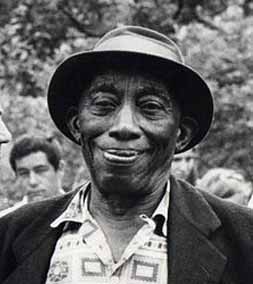 Hurt had the reputation of being a sweet, gentle, almost saintly character, and a lot of people have suggested it was strange that he would sing something like this. Of course, it wasn’t the only erotic song in his repertoire: a rock group got it’s name from the “loving spoonful” chorus of his “
 You have to hold both the fourth and fifth strings on the second fret with your middle finger, so your ring finger can get the seventh on the second string, leaving your little finger free to get that high note on the fourth fret of the first string.
 island it would more likely be a Bahamian anthem like “Out on the Rolling Sea.” But for playing… this is absolutely it.
 The song itself was a World War II hit, with a dozen sheet music covers testifying to all the famous bands and singers who featured it, from Tommy Dorsey to Eddie Cantor, to Joe Venuti and the unrelated Benay Venuta. I was never enthralled by the lyrics and just enjoyed Spence’s guitar versions… until I was preparing this post and heard the
  Stefan knew of me as a writer but had never heard me play, but he trusted Ernie and signed me up. So then I had to figure out how Spence actually played… and immediately realized I had most of it wrong.
 I first tried to persuade Guy to do the video himself, since he was the obvious person, but he refused because he doesn’t like instructional videos. Guy thinks it is important to approach Spence directly and immerse oneself in his music and his world – not only the guitar style, but the Bahamian gospel vocal tradition, and also to develop the physical strength Spence had from a life as a stonemason, and the rhythm of the fishing boats. So he said no, and also declined to help me… but when I played my versions of some Spence pieces for him, he was horrified and pointed out particularly egregious errors, then told me how I should be fingering particular passages… and I listened and asked questions until he began feeling like he was getting too involved with the video project. So we’d end our conversation and I’d spend a few months assimilating his corrections, send him a tape of my current versions, and he’d still be horrified and would correct me some
  more… and it never got to a point where he was happy, but my playing certainly improved and I am infinitely grateful.
 songwriter named Adger M. Pace. An online biography says he was born in South Carolina in 1882 and became the first president of the National Singing Convention, a teacher at the Vaughan School of Music in Lawrenceburg, Tennessee, and the bass singer for the Vaughan Radio Quartet on WOAN, one of the first radio stations in the South.
 Jefferson was the defining “down home blues” artist — quite literally, since as far as I can tell that phrase was first used in print to advertise his records. That was in 1926, when the blues record business was still dominated by women like
 That meant I could learn it, then come up with a different way to sing the song rather than trying to imitate his vocals. It struck me that Jefferson was from Texas, and one of the things about his guitar playing, compared to players from further east, is that he sometimes relaxes into a kind of cowboy strumming — so I went with that, and sing in a cowboy-blues style, closer to someone like
  when I was writing a chapter on blues poetry for my pocket guide for Oxford: The Blues: A Very Short Introduction. In the ballad of Gypsy Davy–which I first heard on one of Woody’s records–a woman runs off with a troupe of Gypsies and her husband follows her and tries to convince her to come home. Being a lord, he has servants, and when he finds his wife is gone he cries:
 As with all the Townes songs I do, I learned this off his Live at the Old Quarter double album from 1973 — it’s the pure, stripped down experience, and reminds me of what he was like live: dry, difficult, and magical. I’ve already written about my experiences of Townes over the years and my problems performing his songs in my post for “
 To me, this is less a song than a modern saloon recitation in the tradition of classics like “The Face on the Barroom Floor,” T. Texas Tyler’s “Deck of Cards,” and Chuck Berry’s “Downbound Train.” It’s only marginally weirder, and similarly moralistic, and in its way it may be the most traditional thing Townes ever wrote.
 Dave’s version… and then it struck me that I could do his version of “Old Blue” with pretty much the same arrangement. So I took a crack at it, liked it, and recorded it with Matt Leavenworth on mandolin and Paul Geremia on harmonica. I pretty much stuck with Dave’s lyrics, but when I tried to sing it like he did, with a sort of long moan on both lines of the chorus, it felt draggy, so I shortened the final line, and was thrilled when Paul said he’d never much liked the song, but that way it worked.
 Memphis working the clubs on Beale Street, and even held down a residency at the eminently fashionable Peabody Hotel. Checking back over his repertoire, I’m struck by how many songs I picked up from people who may well have got them from his records: the flip side of “Old Blue” was “
 Carawan. Back then I had no way to check and I’d forgotten about that note until today, when I went online to see if Carawan ever did it… and, by gum, he did. It’s
  songs… but I ended up working with him by pure happenstance.
  bass player. I suggested myself and Washtub Robbie Phillips, and Howard was skeptical about using a one-string bass… but we went over to Barbara’s and he and Robbie hit it off immediately, both musically and socially.
 And, of course, we played “Barnyard Dance,” the title song from the first Martin, Bogan and Armstrong album. As far as I know, this was another of Howard’s compositions, as was the album cover — which prompted me to ask him if he would paint a cover for the CD I recorded near the end of my time with him, which he graciously did.