
The ultimate fall-into-winter song, by Joni Mitchell, arranged by Dave Van Ronk. I tend to be more optimistic about this season, so my standard autumn song is Bill Morrissey’s “My Baby and Me,” but I always loved the way Dave did this — plus, my Vancouver buddy Monte Jones had a gorgeous harmonica part for it, which he played often with me and a couple of times with Dave… and I wish he was around to play it now.
 This was one of Mitchell’s early masterpieces, though she only recorded it as the b-side of a single and a lot of her fans have never heard it. Tom Rush recorded the best-known version as the title song of one of his albums, and it’s nice, but Dave’s is the killer. He recorded it for Polydor, on an album that had some of his most ornate production and greatest song choices, but didn’t sell and soon went out of print, though it’s now available for digital download (thanks to the
  hoopla around the Coen Brothers’ movie). He also recorded a solo version, which is even better, as the last song on his final album, …and the Tin Pan Bended and the Story Ended. A perfect, elegiac ending.
When I was studying with Dave in the mid-1970s, not many young people were aware of his work, but Joni Mitchell fans sometimes recognized his name because she had said he was the only person who sang her songs better than she did. None of them agreed, of course, but I think I understand what she meant: Dave’s rough growl counteracted the prettiness of the melodies, forcing listeners to hear the power of the poetry.
 Dave first met Joni, then still named Joni Anderson, when they both appeared on a television program Oscar Brand was hosting in Winnipeg, called Let’s Sing Out. It was 1965, nobody south of the border had yet heard of her. He used to tell a funny story about that meeting, which is in our book, The Mayor of MacDougal Street, but the short version is that he was blown away by her writing, her singing, her playing, and her brilliance. He saw her again in Detroit, working in a duo with her husband Chuck, who was one of the few people on the folk scene other than Dave doing Brecht/Weill material, and then she moved to New York and they became fast friends.
Dave thought Joni was the greatest songwriter to come out of the folk revival — not necessarily more talented than Dylan, but in his class for talent and much more serious about the craft. For a while he recorded at least one of her songs on every album, including a version of “Both Sides Now” that was supposed to be his big radio hit but couldn’t compete with Judy Collins. (It may not have helped  that he insisted on calling it “Clouds” — when Joni first sang it for him, he told her that was the dominant image and should be the title. She compromised, keeping her song title, but calling the album Clouds.)
I liked all of Dave’s performances of Mitchell’s material — one of the great pleasures of compiling the CD to go with our book was that I could include a solo version of “Both Sides Now” — but this was always my favorite. So I suggest everyone check it out, and also… there’s now a clip of Joni singing it on Oscar Brand’s TV show, and it’s wonderful. I might even like it more than Dave’s version…
 great taste in songwriters. I first bought one of his albums because I was on a Shel binge and it had a bunch of Silverstein songs I hadn’t heard, which was true of something like a dozen of Bare’s records. He’d been mostly a singles artist until he recorded a double album of Shel’s songs in 1973, Lullabies, Legends, and Lies, which included “Rosalie’s Good Eats Cafe,” a small-town, late-night classic that clocks in at over eight minutes — maybe still a record for a country song without instrumental solos.
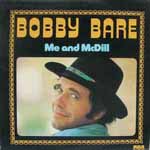 So then it turned out Bare had a whole album of McDill’s songs, and eventually I learned he’d been Billy Joe Shaver’s publisher and persuaded Shaver to stick with the business when no one was recording his songs–though also taking a substantial cut of Shaver’s earnings when Waylon did Honky Tonk Heroes… which, OK, that’s a somewhat ambiguous legacy, but let’s go back from there to his first big hit, “Detroit City,” by Danny Dill and the pre-stardom Mel Tillis; and a couple by the pre-stardom Tom T. Hall, “Margie’s at the Lincoln Park Inn” and “How I Got to Memphis”; and a couple more by the pre-stardom Kris Kristofferson, like “Come Sundown”; and Tompall Glaser and Harlan Howard’s “Streets of Baltimore…” Basically, if you’re looking for good country songwriting–the best of that golden era when writers like Kristofferson and Hall were reinventing the genre–his albums are a good place to find some classics and — more to the point — a lot of less familiar but equally great material.
 some just dopey, some outright dumb… and some walk a bunch of those borderlines, like f’rinstance, “Tequila Sheila.” I’m a fluent Spanish-speaker and deeply engaged with Mexican culture, but there’ s something gloriously silly about rhyming “Sheila” with “Pancho Villa…” and the rest feels to me like an absurdist Western in the same tradition as Cat Ballou… and it always worked well in the bars.
 been recorded by dozens of major artists, from Elton Britt, Gene Autry, Vaughan Monroe, and the Mills Brothers in the 1940s up through Patsy Cline, Ray Charles, Dean Martin, Della Reese, The Drifters, Brooke Benton, Brenda Lee, Ricky Nelson, Willie Nelson… and so on and on.
 or eminently forgettable — “Blackberry Jelly Nellie” and “Ding Dong Dell (The Belle of Chinatown).”
 This one liked me from the first time I played it: the guitar part fell comfortably under my fingers, the lyrics flowed, and it always got a good response. So I’ve been playing it for over thirty years and that’s that.
 with most of the gigs in bars around Montana and the Idaho panhandle. The patrons in those rooms ranged from blues fans to country listeners to folks who were just down for a drink in their local bar, and I was trying to find material that suited their tastes and also fitted with the rest of my repertoire and guitar style. If I hit the right balance, they’d even get up and dance, which never happened in the folk clubs back east.
 In Snow’s case the exploration ended with that one album, but I liked his guitar playing and learned several songs off it. I still do “
 to credit Steve James here, because I worked out a version of that guitar part from McGee’s record, but when Steve and I did a split bill at Johnny D’s in Somerville, Mass, I played it for him in the green room and he straightened me out. He’d actually spent time with Sam McGee, and showed me a couple of cute tricks, like the way McGee played the bass on the E section of that break — instead of alternating between the 6th string and the 5th (actually, the 5th and 4th together), he played the 6th for the first beat, then stayed on the 5th for the next three: 6-5-5-5, 6-5-5-5. I hadn’t noticed that, and it’s a great sound.
 Ombabika, nor have I been to Jellicoe* — both pretty far north in Ontario, though not as far north as Schefferville, Quebec. Nor have I been to Barranquilla, Colombia, or Tocopilla, Chile, and I have no idea what either is doing in this song, nor yet
  I was spurred to learn this by my friend Monte in Vancouver, a Canadian ex-rodeo rider and wonderful harmonica player discussed
 …and finally I’m forced to recall Dave Van Ronk telling me apologetically that despite my fine example he couldn’t bring himself to pick up hitchhikers, because they always insisted on chatting and were almost always boring… and I guess this song is a good example of what he was complaining about.
 which remains a staple of my repertoire.
 one, but he wasn’t biting.
 disproportionately rich and generous in terms of its music.
 The club was Passim Coffeehouse in Harvard Square, and it’s not easy to explain how important it was to me, or in how many ways. For one thing, that’s where I met Dave Van Ronk, who appeared there twice a year for weekend residencies, and where I saw him play dozens of times. For another, it was the first club that booked me for paying gigs, starting with six weekend shows
  and running buddy of Jack Kerouac and Neal Cassidy, mentioned as “Bob Donnelly” in a couple of Kerouac’s novels — but that was a long time before Passim, and by the time I came around he was notoriously taciturn and curmudgeonly. Beyond that, he was a reformed alcoholic and particularly crabby with performers who drank — he loved Dave despite the drinking, but never really warmed to Bill Morrissey, and the lack of affection was mutual. But he was always nice to me, asked about my family, booked me for good showcase gigs, and even smiled and laughed his creaky laugh at some of my jokes.
 As for “Sioux City Sue,” I learned this off the Willie Nelson/Leon Russell double album, which was the first album I had by Willie, and the only one for quite a while. I loved the first record, which had more western swing on it, and learned a bunch of the songs, but this is the only one that stuck with me. It was originally a hit for its composer, Dick Thomas, and then for Gene Autry and Bing Crosby, but I don’t recall hearing any of those versions, and I don’t think I’ve performed it since Bob and Rae Anne finally gave up the coffeehouse. The room is still there, now run as a non-profit (it was at least as non-profitable in their day, but not officially) under the slightly altered name of Club Passim, and I’ve played there a bunch of times since, and it’s still a nice gig… but I miss them.
 Man,” and as soon as I got home I ran out and bought the album, which had one of my favorite titles of all time: Guitars, Cadillacs, Etc., Etc.
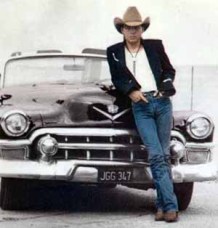 somebody!” He sang the old George Jones weeper like he believed every word, then introduced “one by the Hillbilly Cat — you know who the Hillbilly Cat was?” And tore up Elvis Presley’s “Little Sister.” It was one of the hottest shows I’ve ever seen.
 He said, “No, why?”
 there was a definite shift toward a more rootsy sound — I particularly remember Merle Haggard’s “I Had a Beautiful Time” and Dwight Yoakam’s “Guitars, Cadillacs, and Hillbilly Music,” both playing pretty regularly as Hazel and I drove through eastern Montana and on across North Dakota. We were somewhere in the middle of the badlands when this came on the radio.
 Blanchard & Morgan’s Birds of a Feather, with a sticker on it saying “Featuring Tennessee Bird Walk.” So I put it aside, and when Jeff got home I asked him where he’d got it… and he said, “I’ve never seen that record before in my life.”
 still my favorite take on that standard. So it’s odd that the only song I do of his was learned off an Albert Collins record — but that’s how it goes. (Or maybe it’s that after hearing him sing something, I steered clear of it.) Not only that, I wrote my own third verse, because for some reason I didn’t feel comfortable singing the original one and needed a substitute. And not only that… my verse was probably inspired by Paul Simon’s “Duncan” — which is a hell of an admission, but we’re all friends here, right?
 a brief run of R&B hits in the early 1950s, he was in a car accident that almost killed him and left his face brutally disfigured. He kept writing, and recorded a half-dozen albums in the 1960s and 1970s, including a couple on Ray Charles’s Tangerine label, and toward the end of his life there was a nice documentary about him, filmed mostly at a relaxed party with friends, singing the old songs with Mark Naftalin playing sensitive piano… which, tragically, seems to be out of print, and someone oughta fix that.