
I forget who loaned me the Red Steagall album with this as its title song, but I know it was in Vancouver, BC, and I taped all the songs I liked–which was most of them–and learned this one and “Someday (You’ll Want Me to Want You),” which remains a staple of my repertoire.
At the time I barely knew who Bob Wills was and had never tasted Lone Star, so I’m in Steagall’s debt for introducing me to Western Swing, one of the most exciting and influential byways of American music.
That first album also spurred one of my rare and abortive ventures into songwriting. Under its influence, I composed a pseudo-western swing number called “The Beer Stain on the Counter Looks Like Texas.” I don’t remember the first and only verse, but the chorus went:
That beer stain on the counter looks like Texas,
The peanuts are El Paso and the ashtray’s San Antone.
Yeah, that beer stain on the counter looks like Texas,
And I wish that I was back there now, down in my Texas home.
Which may explain why I don’t do more songwriting. Around the same time I wrote half a George Jones-style weeper called, “If You Lived Here, You’d Be Home by Now.” I tried to get Bill Morrissey to collaborate on that  one, but he wasn’t biting.
I don’t think I’ve heard another Red Steagall album, but along with Willie and Waylon — particularly Waylon, who composed a parallel song, “Bob Wills Is Still the King” — he focused my attention on Texas music, and I’m duly grateful. I’ve since spent a fair amount of time in the state, hitching and driving around and across it, and I won’t claim I know it well, but I’ve certainly developed a deep respect for its musical offspring. I’ve spent many interesting hours immersed in Wills’s canon, and that took me to Spade Cooley and Milton Brown, and then the long line of honky-tonkers following Ernest Tubb, Dave Dexter, and the marvelous Floyd Tillman, and later-generation songwriters like Terry Allen, Jo Carol Pierce, Joe Ely, and Lyle Lovett. Not to mention all the Mexican and Chicano music that’s come out of there, and all the blues, and jazz — Flaco Jimenez, Little Joe, Steve Jordan, Lemon Jefferson, Lightnin’ Hopkins, T-Bone Walker, Ornette Coleman… it’s a big state, but still  disproportionately rich and generous in terms of its music.
And while I’m touching on this subject, I should plug a wonderful book that never got enough attention: Lone Star Swing, by Duncan McLean, a Scottish novelist who won a literary prize that had to be spent on travel outside the UK and, having never been further than London, decided to spend it hunting up Wills’s surviving bandsmen. It’s a very funny book, with a wonderfully off-kilter view of the American southwest, and an affectionate primer on the music. McLean’s Scottish rewrite of “That’s What I Like About the South” is worth the price of admission by itself, notably overshadowing my own half-assed efforts in that direction.
 The club was Passim Coffeehouse in Harvard Square, and it’s not easy to explain how important it was to me, or in how many ways. For one thing, that’s where I met Dave Van Ronk, who appeared there twice a year for weekend residencies, and where I saw him play dozens of times. For another, it was the first club that booked me for paying gigs, starting with six weekend shows
  and running buddy of Jack Kerouac and Neal Cassidy, mentioned as “Bob Donnelly” in a couple of Kerouac’s novels — but that was a long time before Passim, and by the time I came around he was notoriously taciturn and curmudgeonly. Beyond that, he was a reformed alcoholic and particularly crabby with performers who drank — he loved Dave despite the drinking, but never really warmed to Bill Morrissey, and the lack of affection was mutual. But he was always nice to me, asked about my family, booked me for good showcase gigs, and even smiled and laughed his creaky laugh at some of my jokes.
 As for “Sioux City Sue,” I learned this off the Willie Nelson/Leon Russell double album, which was the first album I had by Willie, and the only one for quite a while. I loved the first record, which had more western swing on it, and learned a bunch of the songs, but this is the only one that stuck with me. It was originally a hit for its composer, Dick Thomas, and then for Gene Autry and Bing Crosby, but I don’t recall hearing any of those versions, and I don’t think I’ve performed it since Bob and Rae Anne finally gave up the coffeehouse. The room is still there, now run as a non-profit (it was at least as non-profitable in their day, but not officially) under the slightly altered name of Club Passim, and I’ve played there a bunch of times since, and it’s still a nice gig… but I miss them.
 Man,” and as soon as I got home I ran out and bought the album, which had one of my favorite titles of all time: Guitars, Cadillacs, Etc., Etc.
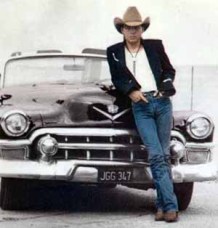 somebody!” He sang the old George Jones weeper like he believed every word, then introduced “one by the Hillbilly Cat — you know who the Hillbilly Cat was?” And tore up Elvis Presley’s “Little Sister.” It was one of the hottest shows I’ve ever seen.
 He said, “No, why?”
 there was a definite shift toward a more rootsy sound — I particularly remember Merle Haggard’s “I Had a Beautiful Time” and Dwight Yoakam’s “Guitars, Cadillacs, and Hillbilly Music,” both playing pretty regularly as Hazel and I drove through eastern Montana and on across North Dakota. We were somewhere in the middle of the badlands when this came on the radio.
 Blanchard & Morgan’s Birds of a Feather, with a sticker on it saying “Featuring Tennessee Bird Walk.” So I put it aside, and when Jeff got home I asked him where he’d got it… and he said, “I’ve never seen that record before in my life.”
 still my favorite take on that standard. So it’s odd that the only song I do of his was learned off an Albert Collins record — but that’s how it goes. (Or maybe it’s that after hearing him sing something, I steered clear of it.) Not only that, I wrote my own third verse, because for some reason I didn’t feel comfortable singing the original one and needed a substitute. And not only that… my verse was probably inspired by Paul Simon’s “Duncan” — which is a hell of an admission, but we’re all friends here, right?
 a brief run of R&B hits in the early 1950s, he was in a car accident that almost killed him and left his face brutally disfigured. He kept writing, and recorded a half-dozen albums in the 1960s and 1970s, including a couple on Ray Charles’s Tangerine label, and toward the end of his life there was a nice documentary about him, filmed mostly at a relaxed party with friends, singing the old songs with Mark Naftalin playing sensitive piano… which, tragically, seems to be out of print, and someone oughta fix that.
 around the same time, along with five other previously unknown compositions from Woody’s huge horde of unpublished tapes and jottings. As Pete explained in the accompanying article, a New York publisher had gotten excited when the Weavers got a hit with “So Long, It’s Been Good to Know Yuh” (the romantic revision of Woody’s old dust bowl ballad, rewritten by Woody himself in hopes of getting a hit), and asked Woody if he had any more songs. Woody said yes, the publisher gave him a tape machine, Woody spent a few weeks singing into it, and when Pete heard the tapes he recalled being “thunderstruck to find sixty or seventy songs among them that I had never seen before in my life.”
 Which is not to say Woody wouldn’t have sung this song for kids — I’m sure he did, and I’m sure they loved it. I’m just guessing he sang it in some other situations as well, with equal success.
 Woogie,” and as Dave Van Ronk used to say, there’s no point in argument. He had as good a claim as anyone, and better than most. In 1925, before any of the other great blues piano players got on record, he recorded a fine version of this piece with a vocal by Dora Carr, his longtime partner on the black vaudeville circuit. It wasn’t titled “boogie woogie,” but that’s what the style would be called after a fellow named Pine Top Smith hit three years later with a piece called “Pine Top’s Boogie Woogie,” and Davenport always claimed he helped Smith arrange and title that record. (The facts are murky, and Peter Silvester, who writes this up in A Left Hand Like God, remains agnostic while seeming to confirm that Davenport helped Smith get the record gig.)
 Be that as it may, Davenport was a terrific pianist — check out his “State Street Jive” if you want to hear a truly amazing bassline — and a fine singer, but he will always be remembered for his namesake piece. It quickly became ubiquitous, and every blues and honky-tonk piano player had to work up a version. The Mississippi Delta player Louise Johnson did a nice one titled “On the Wall,” with comments by Son House, who apparently had stolen Johnson’s affections from Charlie Patton during the ride north to record, and there’s a classic reworking by Ray Charles as “Mess Around,” which was also memorably recorded by Professor Longhair.
 Mississippi mandolin player Charlie McCoy, one an instrumental titled “Jackson Stomp” and the other a vocal blues called “That Lonesome Train Took My Baby Away.” That was the first piece I ever worked out on mandolin, and I’m pretty sure my guitar version came out of it — though it may have happened the other way around. Either way, I worked it up in the early 1980s and was very happy with the arrangement, because it’s so simple. I came out of a ragtime blues tradition, and Dave Van Ronk had taken me further down the piano ragtime road with some diversions into swing, but this is just some simple riffs in E, inspired by piano but falling naturally on the guitar.
 I fell head over heals for this one, and got a good tip from Dave Van Ronk: I told him I was interested in working up an arrangement, and after laughing and nodding through Jordan’s version, he said, “You oughta keep that descending bass line.” So I did, and recorded it, got some local radio play–not much, maybe just on one station, but enough that for the next few years people would occasionally show up at gigs and ask me to play it.
 Jordan was a sax player in Chick Webb’s band, one of the greatest bands of the swing era, and coupled for a while with Ella Fitzgerald, but in the late 1930s he had a brainstorm: amplification was coming in, money was tight, jukeboxes were all the rage, and he realized that records could actually sound hotter with a small group, while amplification meant small bands could play halls that had previously needed big bands. So he hit the road with a tight, swinging, fun little outfit that he called the Tympany 5, though it almost always had at least six members. He wrote or bought a bunch of hot, funny jive songs, starred in comical low-budget movies, made entertaining radio appearances… and by the mid-1940s was the most popular recording star in black America, with millions of white, Latino, and Asian fans thrown in.
 Dave meanwhile had been concentrating on other things. He took a second crack at arranging classic rags on his Ragtime Jug Stompers LP, but handed over the instrumental leads to Danny Kalb, Artie Rose, and Barry Kornfeld, and then he got into modern singer-songwriter styles, formed a rock band, recorded with larger ensembles, and put the fancy guitar work on the back burner.
 because it was so much fun — kind of like the
  time country music, already known throughout the South before Jimmie Rodgers entered a recording studio.
 The song dates back at least to 1905, when Abbott and Seroff quote the Indianapolis Freeman describing a popular comedian “cleaning up with one of Bob Russell’s latest songs, ‘Ragged, but Right’.” There was a prominent black theatrical producer named Bob Russell in that period, and I assume this was him, but I have no other evidence that he wrote songs, so it may have been something he bought from the actual composer, and a reference from 1909 credits it to a performer known only as Shoe Strings. (Handily for this research, Abbott and Seroff titled their book Ragged but Right.)