
I followed the coast from Charleston and the Sea Islands to Savannah, where I failed to find any art students with floor space and ended up sleeping in a park until the sprinklers came on. From there I cut inland through Waycross and Valdosta to Tallahassee, then out the Florida panhandle, busking in bars for a few bucks, drinks, and occasionally beds.  In New Orleans, I had a connection with a spare room and stayed a few days, meeting the wonderful David and Roselyn, who loaned me an amp so I could back a couple of teenage tapdancers on Bourbon Street and became lifelong friends. (There’s more about them in my post for “Iko Iko,” which I worked up during that trip, while waiting for rides).
From New Orleans I hitched down through Morgan city (as told in my post for “Oil Money“) and on to Lafayette. I arrived late in the afternoon, asked where I could hear good Cajun music and was sent down the road to Breaux Bridge, where there was a club called Mulate’s.
 Talk about good directions! Dewey Balfa was playing fiddle with his band, and the food was good, and everybody was dancing — eventually including me, since women kept coming up and offering to show me how. I guess I was a pretty obvious foreigner, since I had a backpack and guitar leaned against my chair, and sometime later a couple of young women asked me if I needed a place to stay and offered me a spare room, and I said yes, and we drank more beer, and then Ricky Skaggs and D.L. Menard came in — Menard was opening for Skaggs at a concert somewhere in the area and brought him down afterwards.
I spent close to a week in Breaux Bridge, staying with Amanda LaFleur, having Thanksgiving dinner at her friend’s parents’ house, where everyone spoke French (but not the kind of French I spoke) and taking a side trip to Mamou, where I ended up playing in a zydeco duo with an accordionist named Ray Fontenot. That night had a kind of comical ending, because Ray’s wife wasn’t comfortable with a “drifter” staying at their place, so he took me to a motel out in the countryside where they explained they had no clean rooms but could give me a dirty room for ten bucks. I took it.
 I don’t think I saw D.L. Menard again that week, but I met him a bunch of times over the years, up in Boston and down in Louisiana. When we did the PBS series River of Song, I insisted he be the featured Cajun musician and we filmed his band playing at a crawfish boil in his backyard. A few years later, when Sandrine and I were living in New Orleans, I brought her to see him because she’d been hearing Cajun announcers on the radio who weren’t native speakers and needed to be convinced that it was a real language, not just Americans speaking bad French. We drove out to D.L.’s place in Erath, and he met us in the yard with his chihuahua named Taco, and waxed eloquent, as always. He was playing every weekend for one of those dopey comic wedding dinner theater things, “Boudreaux and Thibodeaux’s Cajun Wedding,” and loved it — his particular phrase of approbation was, “C’est fast, Jack!”
D.L. had a lot of great phrases. One was: “I got a real good memory, but it’s short.”
Another: “They say it takes all kinds to make a world, but it’s not true. Some of ’em are just there.”
Anyway… he sure did speak fluent Cajun French, and wrote a lot of great songs in that language, and recorded terrific versions of them with his band, the Louisiana Aces. “La Porte en Arrière (The Back Door)” is his most famous, and probably the best-known Cajun song after “Jole Bon.” As he explained to me:
 I put the story in my mind and I took it from the everyday procedures; every once in a while I hear or see that people would get drunk and was too ashamed to go in the front door, that they’d come in through the back door so that nobody could see them….
The everyday procedures, that’s what makes the best songs. Because you don’t pay no attention to what you do every day… Just like water: You wash your hands or wash your face and take your shower, you don’t think nothing of it. But let that water run dry. Where you going to take a shower? See if you don’t notice it right away….
I recorded that song in 1962, and it’s still a hit. That’s a standard now, and I only wish I could write another one like that — front door, or side door, or something.
D.L. was known as “the Cajun Hank Williams,” and he patterned “The Back Door” on Williams’s “Honky Tonk Blues.” He only met Williams once, in 1951, but that night changed his life.
I studied that man, I stayed with him from nine till — well, I left the dance hall at fifteen to one, he played from nine to one, and I stayed in front of that bandstand almost all  the time, and I studied that man from head to toe…
I talked with him for about ten minutes. And he told me, he said, “You’ve got to sing a song from the heart.” I said, “What you mean by that?” I didn’t know what in the hell he meant. And “region music,” he talked to me about region music. I didn’t know what region music was. I was nineteen years old. So more or less half of what he told me went inside here and out the other side….
D.L. particularly remembered Williams telling him he should play his own music:
I said, “Hank,” I said “I never — it’s French music.”
He said, “It’s yours, huh? It’s your music.”
“Well,” I said, “yeah.” I said, “Well, that’s what I grew up in…”
What he said: “It’s good. It’s good music.” He said, “No matter what kind of music you play, if it’s your music,” he said, “it’s good.”
 their hand at the ragtime style.
 of Mills’s 19th century ragtime hits, but at the time, it was not significantly more successful than his “Whistling Rufus,” another title capitalizing on the rage for cakewalks and “coon songs.” He would soon follow these up with other hits, most memorably his tribute to the 1904 World’s Fair, “Meet Me In St. Louis, Louis” and the pseudo-Native American love song, “Red Wing,” which is probably best known today as the melodic source for Woody Guthrie’s “Union Maid.”
 of that early period went unrecorded. It seems safe to assume that some guitarists came up with settings, and as evidence in favor of this assumption, the cover of “Whistling Rufus” showed an African American guitarist apparently playing fingerstyle — an offensively stereotyped image, but all the more suggestive of a familiar tradition of black instrumentalists who played this sort of tune.
 Michael Tyzack. He was a painter, prominent in the art department at the University, and also played trumpet in a trad band. At that point he was living in a big old house where he let me sleep in a spare room, and getting around in a wheelchair because he’d broken up with a woman who did not take kindly to the situation and smashed him into a wrought iron fence with her car, breaking his legs in multiple places. Unsurprisingly he was feeling rather down, seemed to like having company, and said nice things about
  This is generally known as “Winin’ Boy,” but that title is a mistake. Morton sounds like he could be singing those words, so I don’t blame the record folks for getting it wrong, and after they issued it Morton wrote the title that way himself in a couple of letters — but if you listen to him talk about it on his Library of Congress recordings, he clearly says “Winding Ball.”
 Von Schmidt, Dave Van Ronk, and Ian Buchanan, who recorded a nice guitar version on the Elektra Blues Project LP (which he calls “Winding Boy”), inspiring Jorma Kaukonen’s version with Hot Tuna, which made it even more of a standard. All of those people sang Morton’s cleaned-up version, without the filthy verses that only surfaced later, when daring little record labels began exhuming the material that had been censored in earlier releases. I sing the clean version, too, because those verses really are nasty, though historically illuminating.
 Jack’s was a legendary blues and rock venue, with pictures of previous acts including Spider John Koerner, Bonnie Raitt, and George Thorogood on the walls. Somehow they booked me, and I figured I needed some help and pulled in a bunch of friends — John Lincoln Wright came over from the Plough & Stars to sing “San Antonio Rose,” Kenny Holladay jammed on a version of “Mustang Sally” along with a trombone player from the audience, Tom Ghent sang a couple, and I think Peter Keane was there, and Robbie Phillips on washtub bass. I passed Tracy Chapman playing on the street in Harvard Square that afternoon and invited her, but alas she didn’t show.
 As for this song, it isn’t by Woody Guthrie; as any damn fool oughta know, it’s by Merle Haggard. It wasn’t one of his biggest hits — which is to say, he had four number one country hits in a row before it and four after it, but this only made it to number 3 — but it fitted the romantic notion of hobo life I was chasing, and I love the line about “this mental fat I’m chewing.”
 road. I ended up sleeping outside a lot of nights and even taking gainful employment, painting a house in the Georgia Sea Islands in return for a couch, meals, and maybe eight bucks an hour.
 As Merle wrote, you learn things hoboing that they’ll never teach you in a classroom, and if any bright young folks are reading this, I recommend getting out there and seeing what happens. Despite what everybody seems to be saying, it’s not more dangerous now than it used to be. It was always chancy, but most people are pretty decent if you approach them right; the real world isn’t like the movies or the internet.
 walking the last five miles into Southport, North Carolina. On the edge of town I passed a gas station and a skinny old guy came running out, gestured to the guitar I had slung over my shoulder, and asked, “Can you play that thing?”
 and said, “You could have any of them, if you want…” Which I didn’t, but it felt honky-tonk.
 I’d actually cemented a multi-year relationship by responding to my date’s query, “What do you think about Merle Haggard?” by saying, “Merle Haggard is God.” And I’d amassed a pretty fair collection of his LPs. But nothing prepared me for how good he was live. It was a comfortably loose show, with great playing and singing, and Merle doing imitations of other singers, and Bonnie Owens adding harmony, and since the gig was in Shreveport, James Burton was hanging out backstage. It was a night to remember, and he’s still one of my all-time favorites.
 This was one of Mitchell’s early masterpieces, though she only recorded it as the b-side of a single and a lot of her fans have never heard it. Tom Rush recorded the best-known version as the title song of one of his albums, and it’s nice, but Dave’s is the killer. He recorded it for Polydor, on an album that had some of his most ornate production and greatest song choices, but didn’t sell and soon went out of print, though it’s now available for digital download (thanks to the
  hoopla around the Coen Brothers’ movie). He also recorded a solo version, which is even better, as the last song on his final album, …and the Tin Pan Bended and the Story Ended. A perfect, elegiac ending.
 Dave first met Joni, then still named Joni Anderson, when they both appeared on a television program Oscar Brand was hosting in Winnipeg, called Let’s Sing Out. It was 1965, nobody south of the border had yet heard of her. He used to tell a funny story about that meeting, which is in our book, The Mayor of MacDougal Street, but the short version is that he was blown away by her writing, her singing, her playing, and her brilliance. He saw her again in Detroit, working in a duo with her husband Chuck, who was one of the few people on the folk scene other than Dave doing Brecht/Weill material, and then she moved to New York and they became fast friends.
 that he insisted on calling it “Clouds” — when Joni first sang it for him, he told her that was the dominant image and should be the title. She compromised, keeping her song title, but calling the album Clouds.)
 great taste in songwriters. I first bought one of his albums because I was on a Shel binge and it had a bunch of Silverstein songs I hadn’t heard, which was true of something like a dozen of Bare’s records. He’d been mostly a singles artist until he recorded a double album of Shel’s songs in 1973, Lullabies, Legends, and Lies, which included “Rosalie’s Good Eats Cafe,” a small-town, late-night classic that clocks in at over eight minutes — maybe still a record for a country song without instrumental solos.
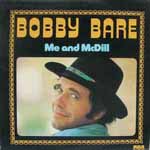 So then it turned out Bare had a whole album of McDill’s songs, and eventually I learned he’d been Billy Joe Shaver’s publisher and persuaded Shaver to stick with the business when no one was recording his songs–though also taking a substantial cut of Shaver’s earnings when Waylon did Honky Tonk Heroes… which, OK, that’s a somewhat ambiguous legacy, but let’s go back from there to his first big hit, “Detroit City,” by Danny Dill and the pre-stardom Mel Tillis; and a couple by the pre-stardom Tom T. Hall, “Margie’s at the Lincoln Park Inn” and “How I Got to Memphis”; and a couple more by the pre-stardom Kris Kristofferson, like “Come Sundown”; and Tompall Glaser and Harlan Howard’s “Streets of Baltimore…” Basically, if you’re looking for good country songwriting–the best of that golden era when writers like Kristofferson and Hall were reinventing the genre–his albums are a good place to find some classics and — more to the point — a lot of less familiar but equally great material.
 some just dopey, some outright dumb… and some walk a bunch of those borderlines, like f’rinstance, “Tequila Sheila.” I’m a fluent Spanish-speaker and deeply engaged with Mexican culture, but there’ s something gloriously silly about rhyming “Sheila” with “Pancho Villa…” and the rest feels to me like an absurdist Western in the same tradition as Cat Ballou… and it always worked well in the bars.
 been recorded by dozens of major artists, from Elton Britt, Gene Autry, Vaughan Monroe, and the Mills Brothers in the 1940s up through Patsy Cline, Ray Charles, Dean Martin, Della Reese, The Drifters, Brooke Benton, Brenda Lee, Ricky Nelson, Willie Nelson… and so on and on.
 or eminently forgettable — “Blackberry Jelly Nellie” and “Ding Dong Dell (The Belle of Chinatown).”
 This one liked me from the first time I played it: the guitar part fell comfortably under my fingers, the lyrics flowed, and it always got a good response. So I’ve been playing it for over thirty years and that’s that.
 with most of the gigs in bars around Montana and the Idaho panhandle. The patrons in those rooms ranged from blues fans to country listeners to folks who were just down for a drink in their local bar, and I was trying to find material that suited their tastes and also fitted with the rest of my repertoire and guitar style. If I hit the right balance, they’d even get up and dance, which never happened in the folk clubs back east.
 In Snow’s case the exploration ended with that one album, but I liked his guitar playing and learned several songs off it. I still do “
 to credit Steve James here, because I worked out a version of that guitar part from McGee’s record, but when Steve and I did a split bill at Johnny D’s in Somerville, Mass, I played it for him in the green room and he straightened me out. He’d actually spent time with Sam McGee, and showed me a couple of cute tricks, like the way McGee played the bass on the E section of that break — instead of alternating between the 6th string and the 5th (actually, the 5th and 4th together), he played the 6th for the first beat, then stayed on the 5th for the next three: 6-5-5-5, 6-5-5-5. I hadn’t noticed that, and it’s a great sound.
 Ombabika, nor have I been to Jellicoe* — both pretty far north in Ontario, though not as far north as Schefferville, Quebec. Nor have I been to Barranquilla, Colombia, or Tocopilla, Chile, and I have no idea what either is doing in this song, nor yet
  I was spurred to learn this by my friend Monte in Vancouver, a Canadian ex-rodeo rider and wonderful harmonica player discussed
 …and finally I’m forced to recall Dave Van Ronk telling me apologetically that despite my fine example he couldn’t bring himself to pick up hitchhikers, because they always insisted on chatting and were almost always boring… and I guess this song is a good example of what he was complaining about.