
When I wrote Escaping the Delta: Robert Johnson and the Invention of the Blues, the original idea was just to go through Robert Johnson’s complete recordings, listen to each of them carefully, and figure out what I could say about them–his sources, his playing, his singing, and how they might have fitted into his life and the process of recording. Part of that project was to figure out how he was playing, which was kind of a departure for me, because I’d never worked out any of his guitar parts, and had never really tried to play slide. For a while I got fascinated with the style, and tried to go on and learn some Kokomo Arnold, Tampa Red, and Casey Bill Weldon arrangements as well, but somehow it just didn’t feel like me…  so I settled for playing a couple of Johnson’s pieces, with some licks from Son House, who seems to have been the main source for his slide style, and this is the one that stuck with me.
House has always been one of my favorite blues artists–I had his Columbia album by my early teens, and it remains one of my favorite records–he was such an astonishing singer, and the vibrato he got with his slide continues to stir me in a way I could never explain and no one else ever equaled (Muddy Waters probably comes closest). He played this guitar part for a song called “My Black Mama,” and used a different accompaniment for his recorded version of “Walking Blues” — but it’s perfectly possible that he was comfortable singing either lyric with either guitar part, and just happened to record them the way he did on those particular days. In any case, I love his work, prefer Johnson’s verses, and think of this as kind of my dual tribute to both of them.

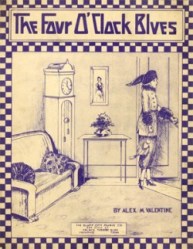 Which said, Dunn’s recording is an instrumental, and the published sheet music has lyrics that bear no resemblance to what Johnson sang… and the song was also published in Memphis around that time with credit to another composer, Alex Valentine… and Skip James recorded a version of the song as “Four O’Clock Blues,” before Johnson did it, with yet another set of lyrics… and Alan Lomax recorded yet another version of the song in 1941 from Son House, Willie Brown, and Fiddlin’ Joe Martin, who could have been Johnson’s source…

 of jazz, blues, international and other LPs, and that was where I first heard Jean-Bosco Mwenda’s playing, on an LP called Guitars of Africa. Like everyone else who heard that record, I was blown away by his instrumental version of Masanga, and fortunately both Pete Seeger and Happy Traum had published tablature for it, so I managed to cobble together a half-assed version.
 recall, Tracey’s notes said that Bosco was in his late teens when he made the recording, circa 1951, and had only been playing for a couple of years–which seemed incredible, but he was a pretty incredible person. (Though, to be fair, he told me a different story when I

 Woody Guthrie is still one of my favorite players and singers–I like his songwriting too, but he gets plenty of credit for that elsewhere, and his musicianship tends to be underrated. On his record of this song, the title is given as “Baltimore to Washington,” and I’ve also seen it as “The Cannonball.”
 …Brownie was mentored as a young musician by a guitarist and singer named Leslie Riddle, who is best known for traveling around the South gathering songs with A.P. Carter and teaching Maybelle Carter how to fingerpick. As she explained:
 And as it happens, one of the songs they learned from Riddle was “Cannonball Blues,” including the guitar part that Woody got from Maybelle and I got from Woody. As Sara said, “That’s kind of the way he picked it… [Maybelle] kind of caught some of her style from him, for that one, especially.”