
Another song by William Moore, whom I first got excited about in the mid-seventies when I worked up a version of his “Ragtime Millionaire.” I kept that in my repertoire, but didn’t pay much attention to the rest of his work till I got back from Africa. Then I began looking around for blues songs with interesting bass rhythms, and found this about the same time I got into Blind Blake’s “Southern Rag.”
 It may be coincidence, but Blake connected those rhythms to the “Geechie” culture of the Georgia Sea Islands and Moore grew up near Savannah — a largely unexplored area for blues guitar research, which I’m tempted to relate to the Bahamian traditions of Joseph Spence and the Bahamian Blind Blake. In any case, Moore recorded this song during his only session in 1928 and it has some of those nice rhythmic touches. I simplified his guitar part and came up with different lyrics, because that was how it felt right to me, but the essential framework is his.
When I started doing this, all I knew about Moore was that he had been a barber in Eastern Virginia, and the main clue for that was a guitar-backed monologue called “Barbershop Rag.” Then, in the early 2000s, I heard from a fellow named Ryan Croxton, who passed along notes from an interview with Moore’s son, William Edsel Moore, by a librarian named Gregg Kimball, who has since published a brief online bio of Moore. It explains that he was born in 1893 in the country outside Savannah, where his father was farming, and moved to Tappahannock, Virginia, around 1920 after marrying a woman from that area.
His son recalled that Moore lived in New Jersey before going to Virginia, and apparently met his wife there. ““It seemed like he roamed, he moved around… I guess traveling and playing music and doing things like that.” Like many musicians of that generation, Moore abandoned secular music as he grew older, getting involved in his local church and mostly playing violin, and his son only recalled him singing blues on a couple of occasions.
“On the third of April in Tappahannock [Emancipation Day], that would be the only time I would see him… He would be on the corner with his guitar and people would be sometimes dropping money in a cup or hat, whatever they had, and sometimes he would play with some other guys, I never knew who they were.”
Moore’s son recalled his father as a “soft spoken,” self-educated man who attained a high level of erudition, writing poems and short stories, and a portrait painter. He enjoyed fishing and hunting, was a crack shot, but apparently overloaded his shotgun one day and blew off the little finger on his left hand, somewhat limiting his chording.
And that’s all I know about William Moore… aside from the music, which still sounds great.
 considered a singing style, so even Lonnie Johnson — the consummate virtuoso who can lay claim to being father of both blues and jazz lead guitar — was advertised as a singer and his few instrumental recordings sold poorly and seem to have had little influence. (They are now widely admired, but I’ve never seen or heard anyone before the 1970s mention them.)
 Delta and got his start as a protégé of Johnson’s, then went on to explore jazz chording and became a foundational figure in the electric style often called Chicago blues. Although he was a unique and important innovator, in later years Lockwood was constantly presented as a follower of Robert Johnson and asked to play the songs Johnson taught him… and since he had grown beyond that style by his teens, he eventually acquired a reputation among blues scholars and interviewers for being grumpy and uncooperative.
 So I did, and played him a bit of this, and he took the guitar out of my hands and played a much better facsimile of “West Coast Blues” than I will ever manage.
 hours Paul refretted my guitar and Jack talked — which is what Jack does, brilliantly, and is why they call him Ramblin’ Jack — and then Paul handed me the newly fretted guitar and I played some ragtime licks, and Jack asked, “Can you play Blind Blake’s ‘Southern Rag’?” So I started playing this, and damned if Jack didn’t start doing Blake’s spoken routine from the record, word for word:
 I’d heard Macharia’s song on a wonderful album, The Nairobi Sound, released by a wonderful record label, Original Music. It was the brainchild of John Storm Roberts, a freelance musicologist and all-around-charming fellow whom I had the pleasure of meeting when
 I had also read Roberts’s Black Music of Two Worlds, a wide-ranging and insightful history of the ongoing cross-fertilization between musicians and musical styles in Africa and the Americas. It explained, for example, how Cuban recordings by groups like the Trio Matamoros had influenced Congolese music, and touched on the role of US country music throughout sub-Saharan Africa — which prepared me for conversations about cowboy singers everywhere from Zimbabwe to Kenya. In fact, it was an offhand comment by Roberts that named my band and CD (both of which I’ll get to in future posts): he was telling me about the influence of Jimmie Rodgers, saying he’d collected Rodgers imitations in 24 African languages, and mentioned an early reference in print to “the streetcorner cowboys of Zanzibar,” which instantly struck me as a great name for a band. (When I got to Nairobi, after hitching through the forests of Zaire and up through Burundi, Rwanda, and Uganda, there was still a program on the radio every Sunday of “old Kikuyu music,” which consisted largely of Kikuyu yodeling cowboy songs by folks like
  I think of this piece as kind of a tribute to John, since he was the person who made me aware that any discussion of overlaps and similarities between African and American music has to consider not only the huge influence of African traditions on the music of the Americas, but also the huge influence of Cuban, Argentine, French Caribbean, and US styles on African musicians all over the continent. Even before records became common, minstrel shows and Negro spirituals were imported and adapted into African traditions. (The banjo, for example, is originally a West African instrument, but was introduced to new regions of Africa — and reintroduced in West Africa — with minstrelsy.)
 Masengo, by contrast, had little if any career outside music, and his period of success was long in the past. He had gone to Kenya in the late 1950s, apparently as a member of Je-co-ke (short for Jeunes Comiques du Katanga), a touring group of musicians, singers, and dancers from Lubumbashi (then still known as Elizabethville). An advertising agency in Nairobi heard him, took him on, and he soon became a popular radio and recording artist, sponsored by Coca-Cola.
 He was remembered as a notable musician, and I had the pleasure of performing with him at a local hotel and on a national television special. But he was also considered a bit of a sad story, down on his luck and too fond of the local beer.
 I recorded one long session in his room, with my friend Dominic adding percussion and me playing lead guitar on a couple of the less distinctively Congolese tunes. (I’ve uploaded one, “
 those influences and created a style that was distinctively his own, performed in Swahili and occasionally Kiyeke, the languages of his listeners.
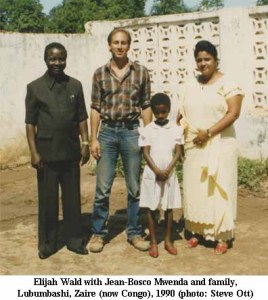 , where a lot of songs give advice on proper behavior (Bosco’s “
 That seemed very generous, since we hadn’t met — but I had no idea how generous until I saw the house. It was a single room, 3×3 meters square, which was actually pretty luxurious when you consider that the room next door was the same size and housed a whole family. Still, it was tight when you consider that Dominic had all his possessions, and a stove, and a bed… if you look at the picture, you see my bed folded outside, which is where I had to put it first thing in the morning so there would be enough floor space for him to get up. And that was before he got married, which happened while I was staying there…
 I’ll have more about that Lubumbashi period in the next couple of posts, but for now I’ll just add that I went on to co-produce a CD of Dominic playing in the classic Congolese style and accompanied him on a few tracks, and he’s got a bunch of videos online, including one we did together in Brussels almost ten years ago of the Kenyan classic, “Malaika”:
 As I wrote in my post on Bosco’s masterpiece, “
 , I played him my inaccurate version of “Masanga,” and he said he would be happy to teach me to play it right and show me some other songs. So for the next month I went over to his house twice a week, had lunch with him, and got a guitar lesson. (The letter I’d sent two months earlier finally arrived a week or so after our meeting.)
 That was probably the high point of my interest in Cooder, and I have to say it was always more interest than love. I loved the idea of his albums, especially in the Chicken Skin Music period when he was mixing odd assemblages of musicians from disparate traditions and choosing unlikely material to do with them. That was my first taste of
  songs, which just proves how out of step I am with a lot of parts of the world, because for a lot of people Reeves was the greatest singer the US ever produced, and they live in some surprising places. For instance Norway, Kenya, South Africa, and India… and I’ve got a story about that:
 People have often asked if I was really able to make a living that way, and the honest answer is I’ve never lived better than during that period in Antwerp. I was staying in my girlfriend Miet’s apartment, paying some utilities and buying food, but I think she covered most if not all of the rent, which in any case was low. I could make the equivalent of about ten dollars per terrace, which took about fifteen minutes, and on a sunny weekend I could go across the Schelde to the cluster of cafes on the other side and often made two or three hundred dollars. If I felt like working some more, I could do the restaurants and bars in the evening, but after I came up with a regular terrace circuit I usually took the evenings off.
 I was doing a lot of traveling as well, because it was easy — wherever I went, I could make food money with my guitar, there were always people ready to provide a bed or couch, and the Antwerp earnings provided a cushion. I hitched up to the north of Scotland and caught a ferry to Orkney, hitched down through Italy and caught a ferry to Tunisia (I remember reading Tom Jones on that trip), and rambled through Hungary, Romania, Bulgaria, and Turkey with my buddy Jasper (I was reading Piers Plowman, or rather not reading it, because that one was unreadable — and also impossible to trade away once I gave up).
 liked his painting, never went in, but the terraces were great for busking and there was a good used bookstore next door) and an easy walk to the cafes by the central station in one direction and the cafes near the Groenplaats in the other.