Dave Van Ronk/Elijah Wald – The Mayor of MacDougal Street
[Home] [Bio] [Jelly Roll Blues] [Robert Johnson] [Dave Van Ronk] [Narcocorrido] [Dylan Goes Electric] [Beatles/Pop book] [The Dozens] [The Blues] [Josh White] [Hitchhiking] [Other writing] [Musical projects] [Joseph Spence]
Dave
Van Ronk and book review links
Dave Van Ronk listening guide
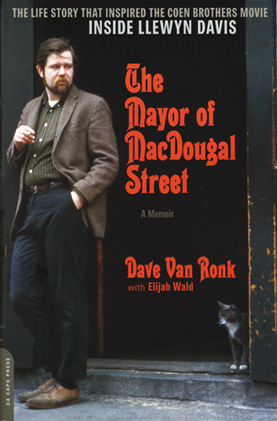 Dave
Van Ronk's memoir of the "Great Folk Scare" of the 1960s, written
with Elijah Wald
Dave
Van Ronk's memoir of the "Great Folk Scare" of the 1960s, written
with Elijah Wald
(Da Capo 2005, new edition 2013)
Now also available in Japanese, in French and Italian as Manhattan Folk Story and in German as Der König von Greenwich Village.
The inspiration for the Coen Brothers' film Inside Llewyn Davis.
"The Mayor of MacDougal Street is one of the dozen best books ever written about a New York life and time: dense with wisdom, humor, judgment, and an amazingly vivid recreation of the rites and rituals and characters of a whole lost world and scene."
--Adam Gopnik, The New Yorker
"a wise and very funny book."
--Louis Menand, The New Yorker
"In Greenwich Village, Van Ronk was king of the street, he reigned
supreme."
-- Bob Dylan, Chronicles, Vol.1
"In the engine room of the NY Folk Scene shoveling coal into the
furnace, one Big Man rules. Dog faced roustabout
songster. Bluesman, Dave Van Ronk. Long may he howl."
--Tom Waits
 “Best Book of 2005” --“If you
thought Bob Dylan’s Chronicles emanated atmosphere, try
Van Ronk’s salty, seamless, and often hilarious re-creation of
Greenwich Village…Where his Bobness could be frustratingly oblique,
Van Ronk is concrete to the point of 3-D.”
“Best Book of 2005” --“If you
thought Bob Dylan’s Chronicles emanated atmosphere, try
Van Ronk’s salty, seamless, and often hilarious re-creation of
Greenwich Village…Where his Bobness could be frustratingly oblique,
Van Ronk is concrete to the point of 3-D.”
-- Library Journal
". . . a funny, insightful and honest recounting . . . Many readers
may go to the book looking for stories about other people including
Dylan -- and they are here -- but along the way they will discover,
or rediscover, the story of Dave Van Ronk."
-- Scott Bauer, Associated Press
"Charming, evocative autobiography by one of the key figures in
the mid-20th-century folk revival. . . . A must for those with an interest
in the music, and of great appeal as well for anyone who enjoys a roistering
life story recounted in a lively narrative voice."
-- Kirkus Review
"Dave Van Ronk's memoirs uncannily evoke
the life, times and voice of an artist I dearly loved."
-- Sean Wilentz, choosing his three favorite books of
2005
Dave
Van Ronk was a founding father of the 1960s folk and blues revivals,
but he was far more than that. For one thing, he was a marvelous raconteur,
one of the funniest and most quotable figures on the Village scene.
His stories of the fifties and sixties, populated by legends like
Mississippi John Hurt, Rev. Gary Davis, Brownie McGhee, and young
friends like Bob Dylan, Phil Ochs and Joni Mitchell, have a vibrant
humor and keen insight unlike any other history of that period. Dave
honed his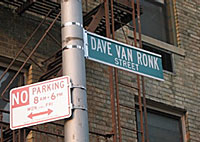 tales along with his music,
while holding court in cafes, bars, and from his apartment on Sheridan
Square. As a musician, mentor, and barroom philosopher, his influence
was so great that the block he lived on was recently renamed Dave Van
Ronk Street. (For an overview of his recordings, check out my annotated guide.)
tales along with his music,
while holding court in cafes, bars, and from his apartment on Sheridan
Square. As a musician, mentor, and barroom philosopher, his influence
was so great that the block he lived on was recently renamed Dave Van
Ronk Street. (For an overview of his recordings, check out my annotated guide.)
This is an honor that would have made him particularly happy, because much as he loved music, he loved the Village almost as deeply. From the time he moved there in the early 1950s until his death in February of 2002, he never considered living anywhere else. Indeed, his memoir ends in the late 1960s, as much because of the change in the neighborhood as the change in the music scene. All his old friends were moving to places like Woodstock or the West Coast, and he found this sad and inexplicable. He loved New York, and that love comes through in his memoir.
Dave grew up in Brooklyn and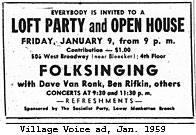 Queens, but escaped to the Village in his early teens to work with various
trad jazz bands. His book tells of those early years, and then of his
discovery of the folksingers in Washington Square Park. He became a
regular in the park, in between trips as a merchant seaman, and gradually
developed a following that grew along with the burgeoning interest in
traditional American music. He was one of the first white, urban singers
to find his own voice in the blues idiom, and his recordings from the
late 1950s already show his unique style. (For a taste of this early
style, listen to this unreleased track from the
late 1950s.)
Queens, but escaped to the Village in his early teens to work with various
trad jazz bands. His book tells of those early years, and then of his
discovery of the folksingers in Washington Square Park. He became a
regular in the park, in between trips as a merchant seaman, and gradually
developed a following that grew along with the burgeoning interest in
traditional American music. He was one of the first white, urban singers
to find his own voice in the blues idiom, and his recordings from the
late 1950s already show his unique style. (For a taste of this early
style, listen to this unreleased track from the
late 1950s.)
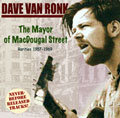 (I compiled
a companion to the book, consisting of unreleased recordings of Dave from the fifties and sixties.
It includes a cappella ballads, blues, jazz, rock, and even some Troskyist
bluegrass. For more information, follow this
link.)
(I compiled
a companion to the book, consisting of unreleased recordings of Dave from the fifties and sixties.
It includes a cappella ballads, blues, jazz, rock, and even some Troskyist
bluegrass. For more information, follow this
link.)
Unlike many histories of the folk revival, which begin when Bob Dylan and Joan Baez hit the scene, Dave's is more than half finished by the time Dylan shows up (to spend much of his first year sleeping on Dave's couch). By then, Dave was already ruling the booming block of folk clubs that gives the book its title, and Dylan would tell early interviewers that his dream was to some day be as popular as Dave Van Ronk . . .
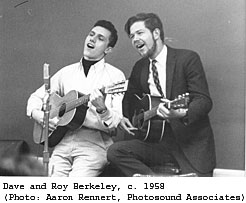 As
a result, the early part of this story recalls not only familiar names
like the New Lost City Ramblers, Josh White and Odetta, but also performers
who are little remembered today but had a profound influence on the
younger musicians who flooded into the Village in the sixties. There
are Paul Clayton, one of Dave's closest friends and a formative influence
on Dylan, Roy Berkeley, "The Traveling Troskyist Troubadour," and Lee
Hoffman, whose Caravan magazine was the folk 'zine of the Village
scene -- as well as a host of anarchists, petty crooks, and unclassifiable
characters.
As
a result, the early part of this story recalls not only familiar names
like the New Lost City Ramblers, Josh White and Odetta, but also performers
who are little remembered today but had a profound influence on the
younger musicians who flooded into the Village in the sixties. There
are Paul Clayton, one of Dave's closest friends and a formative influence
on Dylan, Roy Berkeley, "The Traveling Troskyist Troubadour," and Lee
Hoffman, whose Caravan magazine was the folk 'zine of the Village
scene -- as well as a host of anarchists, petty crooks, and unclassifiable
characters.
When the Kingston Trio were followed by
Peter, Paul and Mary (a group that for a moment 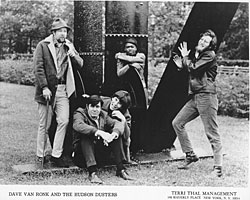 threatened
to be Peter, Dave and Mary), and a new generation of singer-songwriters
transformed the folk world forever, Dave remained in the forefront.
From Dylan to Joni Mitchell, many of the greatest talents arriving in
New York found him a close friend, gallant host, and eloquent interpreter
of their work. Dave even briefly went electric, with the Hudson Dusters,
a psychedelic folk-rock outfit that produced one record, almost got
a hit with Mitchell's "Both Sides Now," and always
remained one of his treasured memories.
threatened
to be Peter, Dave and Mary), and a new generation of singer-songwriters
transformed the folk world forever, Dave remained in the forefront.
From Dylan to Joni Mitchell, many of the greatest talents arriving in
New York found him a close friend, gallant host, and eloquent interpreter
of their work. Dave even briefly went electric, with the Hudson Dusters,
a psychedelic folk-rock outfit that produced one record, almost got
a hit with Mitchell's "Both Sides Now," and always
remained one of his treasured memories.
To buy a copy: I of course recommend that everyone buy from their local bookstore, and if you need to buy online, you can still support independent bookstores by buying it from Indiebound.
Here is some other Ronkiana you might want to check out:
Thoughts on Dave, Dylan, and Robert Johnson, by Elijah Wald
A lengthy interview with Dave.
The Smithsonian/Folkways album of his last concert, complete with new songs and wonderful stories, ". . . and the tin pan bended, and the story ended . . ."
A comprehensive, illustrated Van Ronk discography.
Mark Greenberg's Sidetracks, featuring my commentary and spoken song notes for the Rootstock CD.
PRESS COVERAGE FOR THE MAYOR OF MACDOUGAL STREET :
Review by Robert Christgau, for the Village Voice Bonus track: "Take
a Whiff on Me"
Review from Kirkus Reviews
This live track from the late 1950s gives
a taste of how Dave sounded in his formative years, around the time
he was recording his first Folkways album. It is particularly interesting
because he recycled most of the verses for his version of Rev. Gary
Davis's "Cocaine Blues," his trademark number in the early
1960s. To hear more Van Ronk rarities from the
1950s and 1960s, including ballads, blues, Trotskyist satire and original
compositions, check out the CD The Mayor
of MacDougal Street (R