
My love affair with Texas roots music began in the Cambridge Public Library. The main branch of the library was located in the open space between the two high schools, Rindge Tech and Cambridge High and Latin, and if you had a note from a teacher saying that you had no classes, you could use it during school hours. I spent some time browsing in the stacks, but mostly took advantage of the fabulous  record collection. The music librarian, a tall, quiet jazz enthusiast named Ken Williams (who I recently learned was a pioneering activist against Apartheid), had assembled a relatively small but wonderful assortment of LPs, and there were a couple of turntables where you could listen to them, and I spent hours and days and weeks sitting with a pair of old gray headphones on my ears, getting an education. Among other treasures, that’s where I discovered Guitars of Africa, with Jean-Bosco Mwenda’s “Masanga” (I have an earlier post about studying with him in the Congo), and one of the albums that forever shaped my musical taste, Doug Sahm and Band.
I can’t begin to describe how unlikely and unusual that album was in the mid-1970s. We’ve since had forty years of “roots music” and “Americana,” and all of us are a t least glancingly aware of Tex-Mex accordion, and bluegrass, and traditional fiddling, and classic R&B, and blues, and New Orleans music, and roots rock, and have heard bands that attempt various fusions of those styles. But back then no one had ever attempted a fusion even vaguely comparable to Sahm’s, and no one before or since has assembled a comparable band. Jerry Wexler, at the height of his powers at Atlantic Records, had decided Doug was the quintessential American musician, and between them they assembled… well, let’s put it this way: Bob Dylan, then in his hermit period, came out of the shadows to sing harmony, contribute a new song, and play occasional harmonica; Flaco Jimenez was on accordion; Dr. John was on piano; David “Fathead” Newman was there from the Ray Charles band on tenor sax; David
  Bromberg played dobro; Charlie McCoy played steel; Andy Statman was on mandolin; Kenny Kosek was on fiddle… and of course there was Doug, on fiddle and electric guitar and vocals, and his Texas buddies, Augie Meyers and Jack Barber… there were a few others, but you get the idea.
As for the songs, they ranged from T-Bone Walker to the Delmore Brothers, to… I’m going to stop now, because you should just check it out, though I should mention that Sahm had a couple of his own well-written songs on there as well.
I listened to that LP over and over, probably wore out the library’s copy, and then, because the American record-buying public inexplicably failed to share my tastes, I found a copy in a cut-out bin and wore that out as well. But, oddly enough, I only learned one song off it, Doug’s version of this Charley Pride hit, which he leads off on twin fiddles with Kosek, after shouting, “This is a song about my home town!”
I still have that intro etched in my brain, along with the horn chart from “Dealer’s Blues,” and have made some attempt to capture it on guitar.
 . It matched Kris’s unique background: Vietnam, Oxford University, flying helicopters to oil rigs, emptying ashtrays at Columbia’s Nashville studio. But I didn’t know that at the time; I just knew how much I loved his writing. In retrospect some of the songs feel a little over-romantic — in a 19th century literary sense — but I was the right age for that, and others have held up as well as any songs I know. I’ll probably get to “Me and Bobby McGee” before this project is over, because overdone as it is, it’s a great song; and I don’t think I can write about busking in Norway without doing “Help Me Make It Through the Night”; and I don’t know many better phrases than “Sunday Morning Comin’ Down,” and have a soft spot for “Just the Other Side of Nowhere”…
 who was acting as the bandleader, if he had a set list for the show I’d just heard, and behind me Kris quietly said, “You got a pen?” And then, while his band drank beer and relaxed, he wrote out the set for me. That may not sound like much, but headliners don’t typically act that way — not to mention headliners who are also movie stars. But he has always been atypical, in a lot of ways: that night, he’d done a country set about the Nicaraguan revolution, including a moment when he named Sandino, Che Guevara, and other Latin American revolutionary heroes, and the bandmembers pumped fists in the air and yelled “¡Presente!” after each name. (The album was called Third World Warrior. It wasn’t a great record, but it was heartfelt and a very unusual project to be touring around county fairs in middle America in 1990.)
 She was, presumably, one of the “yellow women” whose doorbells the singer would no longer be ringing. At the time I had no idea what the word “yellow” meant in that context, though I’m pretty sure I understood him to be talking about prostitutes.
 — about light-skinned black women. And that, in turn, leads into the complex and brutal history of colonialism and slavery, and in particular the long history of white men publicly decrying the idea of white-black sexual relations while privately indulging by means of rape and economic coercion… and the pervasive double standard whereby women who fail to remain “pure,” whether voluntarily or not, get blamed for being temptresses, or loose, or whores.
 old-time country blues recordings; and I guess I was already something of a loner and a contrarian by age five, more attuned to Woody Guthrie than to the perky collegiate approach. In any case, I missed the Kingston Trio, the Chad Mitchell Trio, the Brothers Four, and only heard Peter, Paul and Mary because my little sister liked them, but never listened to them voluntarily.
 and fooling around with my own variation of the bass part, because it was fun. And then there was José Feliciano…
 I never heard him during my childhood, because he didn’t like to play in front of people. But he had all the right records, and there were a few years when I guess he didn’t have a regular place to live, or anyway a place for the records, so he left them with us. That’s where I first heard Joseph Spence, and Jelly Roll Morton, and he had all the first round of country blues reissue albums, starting with the canonical, seminal The Country Blues, compiled by Samuel B. Charters.
 that they rushed out their own anthology, Really! The Country Blues, which didn’t include any urban artists. It was great, too, and my brother had both of them, so I also got to hear Tommy Johnson’s “Maggie Campbell” and Skip James singing “Devil Got My Woman.”
 , John Held, Jr. The concept behind the book was to preserve the songs men used to sing in saloons, which were endangered due to Prohibition — which had not ended drinking, by any means, but had ended loud singing around the piano in the local bar. (Held also illustrated a book called The Saloon in the Home, or a Garden of Rumblossoms, which purported to present an evenhanded debate for and against Prohibition, the “pro” side represented by severe tracts on temperance and the dangers of alcohol, and the “anti” represented by cocktail recipes.)
 at a map of Liberia, and found a Robertsport, which sounded enough like “Robert’s Falls” that I called Dave and asked if the song was Liberian, and indeed it was.
 him in concert. It was a split bill with Patrick Sky at Jordan Hall, with Patrick on first, and he and Dave had clearly been doing some drinking ahead of time, but both were in great form. Patrick’s set included “The Pope,” off Songs That Made America Famous, which caused my mother literally to fall out of her seat, she was laughing so hard. (The clincher was probably, “They know that they could never quibble/With a man who is infallibibble!”)
 loved Dylan Thomas and always regretted that she had never seen one of his legendary, boozy, brilliant, hypnotic readings, walked out saying, “That must be what it was like to see Dylan Thomas.”
 and I’m guessing it was supposed to be the title song, since when I mentioned that album to him, Dave’s response was a pained grimace and the comment, “They even got the title wrong.” I never figured out why he disliked that album so much, and am convinced the problems were in the process rather than the result, since the result was one of his best records, with a terrific range of material, from old country blues to
  Charley Jordan, recorded in 1930, but Dave sang different verses, changed the chorus, and set it to a guitar arrangement that bore no relation to Jordan’s. Unfortunately for those of us who enjoyed that arrangement, this was during a passing period of infatuation with open C tuning, and by the time I knew him he’d dropped it from his repertoire — when I asked him to teach me the chart, he said he couldn’t remember it. However, the obvious inspiration was Lemon Jefferson’s “Bad Luck Blues,” which is in standard tuning, so I copped that — not very well, for the first few decades, but four or five years ago I went through an intensive Blind Lemon period and figured out the nice move from C up to D in the opening riff.
 sung in barrelhouses. I first heard it from Mississippi John Hurt, and still play pretty much his version, though I seem to have picked up some vocal inflections from Lead Belly, and wouldn’t be surprised if Jack Elliott gets in there as well.
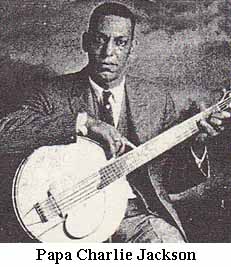 “my buddy” as the person who caught the singer kissing his wife, refers to “Uncle Bud,” a legendary figure of black folksong, and “kissing” would not have been the word used in barrelhouse performances. Zora Neale Hurston sings a common variant of “Uncle Bud” on a Library of Congress recording, and a typical verse goes: