
“Monday Morning Blues” was a late arrival in my John Hurt repertoire. I always loved and played his music, but only began to study it carefully after I got back from Africa in the 1990s. In previous posts I’ve told how I became fascinated with the odd chord positions in “Richlands Woman” and the rhythmic trickeration of “Satisfied and Tickled Too,” and finally learned the thick E7 chord he uses in “Candy Man.”
That last development only happened when I began to get teaching gigs at guitar camps and decided I wanted to do a John Hurt class. That meant not only figuring out what he was doing, but putting together a group of his pieces in a way that would be helpful to students who only had a week to assimilate what I was showing them, and I learned “Monday Morning Blues” and “Trouble, I’ve Had  It All My Days” to show how Hurt used the same fifth position partial D chord in both, with somewhat different effects. As it happens, I then started using the riff from this song in the breaks of Hurt’s “Coffee Blues,” and later realized that Dave Van Ronk and Gary Davis used it in “‘Bout a Spoonful,” which is a version of that song…
…all of which may be of some fleeting interest to people who want to play Hurt’s style…
…but I’m going over this story because that process transformed the way I thought about learning other people’s guitar arrangements. I started playing Hurt’s songs in my teens, and like a lot of people, I thought of his style as relatively simple and straightforward. I learned to play nice, regular versions of his stuff, and they sounded enough like his versions that it was at least twenty years before I realized that he played those songs quite differently and his way was more interesting.
That was when I began thinking of vernacular guitarists as having their own individual languages, and trying to learn their styles the way I would study a language. People like Hurt, Davis, Lemon Jefferson and Joseph Spence worked out their arrangements by playing songs over and over, using techniques that felt comfortable and natural to them. I had approached those arrangements as unique compositions, trying to figure them out note by note and often twisting my hands into difficult positions to get the sounds I thought I was hearing — but if you actually work out how any of those musicians played a piece, you find that all the moves fell naturally under their hands.
That doesn’t always mean all the moves are easy — Davis and Spence in particular were virtuosos, and knowing how their hands moved doesn’t mean you can make your hands move the same way. But, as with learning a language, you can play their arrangements much more comfortably if your hands get a general fluency in their ways of moving than if you try to learn their pieces as separate compositions.
 At least that’s my take, and I made John Hurt my first test case, learning a couple of dozen of his pieces and assuming that when something felt uncomfortable I was doing it wrong. In the process, I learned a lot of songs I had passed over in the past, including this one. I learned this as an exercise, and the more I played it, the more I loved it. I like the way the lyric limns a story in short phrases, I like the quirky additional measure in the E section — and, most of all, I love the way it feels. Once I got my hands to do what his hands did, it felt like walking down a well-worn path — not working to sound like him, just ambling along in his footsteps
 brand. Then he’d tell how he used to know a woman who made him that good Maxwell House coffee every morning, but one day she went away — some said to Memphis, some said to Leland — and he wrote this song about her. That’s what he was thinking about when he sang that he wanted her “loving spoonful.”
 When I started to play fingerpicking guitar, John Hurt pretty much defined that style — after Elizabeth Cotten’s “
 I recently was re-inspired by a
  I have to again give credit to Guy Droussart, who was kind enough to explain many of Spence’s favorite moves to me. One of the fascinating things about learning the style of any vernacular guitarist — meaning players who work out arrangements by playing pieces over and over — is that their arrangements flow logically out of the way they use their hands, and are comfortable to play if you can figure out how they are using their hands. Guy gave me the clues I needed to get this close to what Spence was doing — not all the intricacies, subtleties, and virtuosity of his playing, but the basic style.
 I was particularly struck by how much Willie was enjoying himself — he had that great band, with his sister on piano and Mickey Raphael on harmonica, and he just kept playing and playing, then finally ended, came back for an encore, and played at least another half hour. The band looked exhausted, but he clearly didn’t want to leave, and neither did I.
 I heard this on an LP called Honky Tonkin’, which I picked up in a cut-out bin for a buck or so — a good deal, since it also had Willie’s gorgeous version of “Crazy Arms,” and Gary Stewart doing “She’s Actin’ Single (I’m Drinkin’ Doubles),” and
  I’d been aware of Guy Clark sort of tangentially for a long time, but tended to scratch my itch for Texas songwriters with
  explained in
  Notre Dame in Paris, and the other of him as a kid in Brooklyn. But the designer who did the jacket had ideas of her own and decided to just use the Notre Dame shot… which she didn’t mention until after sending it to the printer… and although I managed to use it twenty years later in our book,
  showpieces. As explained in earlier posts, I shied away from most of Davis’s material because I was not interested in performing gospel songs, and for quite a while this was my favorite of his LPs — an opinion I later revised because he was such a spectacular singer, but by then I had practically memorized the first side of this album.

 G7 uses the classic Davis C7 shape, also favored by Dave Van Ronk and Jim Kweskin (and me), with the thumb wrapping two bass strings. (Now that I think of it, that D7 chord should also have the thumb wrapping two strings to get the root note in the bass.)
 owned, handed down from my half-brother Dave, and I never managed to learn anything from it. Some of his later books were very helpful, but I’m convinced that this kind of Delta blues doesn’t translate to the printed page — it’s all about the rhythm and feel, and knowing what notes someone is hitting doesn’t help much. Another thing that didn’t help was that at that point I hadn’t heard Willie Brown’s version, or House’s, or any of the various songs Patton sang with a similar arrangement, or Tommy Johnson’s “Maggie Campbell…”
 which were in the Grossman book. They were great, and I learned his “M&O Blues,” but I didn’t even attempt to learn this one. I was 16 years old, studying with Dave Van Ronk, and this style of guitar was too different from anything I knew how to play.
 House called this “The Jinx,” and he played it slower than Brown, at least when he was recording. As I recall, I started by learning his version, then mixed it with Brown’s. In any case, it turned out to be a conceptual breakthrough for me: Like a lot of white revival players, I always felt more comfortable with my blues guitar playing than my blues singing, and as a result I tended to work out a guitar part, then try to sing over it as best I could. That was particularly tricky on pieces like this, because of the way the rhythmic accents switch between on- and off-beats — but listening to House, it struck me that his guitar was following his singing. So rather than trying to perfect the guitar accents , I tried to concentrate on my singing and let the guitar follow… and to sing it like I was involved with the lyric rather than trying to sound like House or Brown… and suddenly everything felt right.
 I think I’d already heard Rev. Gary Davis, and I’m sure I’d heard Brownie McGhee and Sonny Terry, but their tracks on that LP are still the ones I recall most clearly.
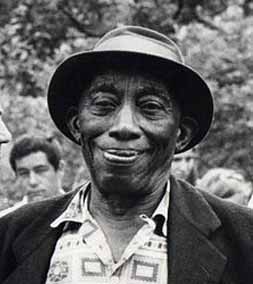 Hurt had the reputation of being a sweet, gentle, almost saintly character, and a lot of people have suggested it was strange that he would sing something like this. Of course, it wasn’t the only erotic song in his repertoire: a rock group got it’s name from the “loving spoonful” chorus of his “
 You have to hold both the fourth and fifth strings on the second fret with your middle finger, so your ring finger can get the seventh on the second string, leaving your little finger free to get that high note on the fourth fret of the first string.
 island it would more likely be a Bahamian anthem like “Out on the Rolling Sea.” But for playing… this is absolutely it.
 The song itself was a World War II hit, with a dozen sheet music covers testifying to all the famous bands and singers who featured it, from Tommy Dorsey to Eddie Cantor, to Joe Venuti and the unrelated Benay Venuta. I was never enthralled by the lyrics and just enjoyed Spence’s guitar versions… until I was preparing this post and heard the