This is probably my all-time favorite summer song — partly because of the lyrics and the way they fit with the melody, and partly because the guitar arrangement fell together so comfortably. It may have taken an hour or so, just playing and seeing what felt right, and that was over thirty years ago, and I don’t think I’ve changed a note.
I’d been aware of Guy Clark sort of tangentially for a long time, but tended to scratch my itch for Texas songwriters with Townes Van Zandt and Joe Ely (and, via Ely, Butch Hancock). Then Guy started coming through the Boston area regularly, and the first time I saw him I was blown away. As it turned out, almost all the songs that blew me away were from his first album, Old No1. Over the years I’ve learned half the songs on that record, and wouldn’t mind learning the other half, but as with Kris Kristofferson, I pretty much got stuck on the first album. Except…
…this is the song of Clark’s I play most often and it’s from a much later album, Old Friends, which I don’t even remember owning. My guess is I got it as a comp back when I was reviewing for the Boston Globe, listened a couple of times, and that was that, except for this one, which I instantly fell in love with. As it happens, the only other Clark song I’ve put up in this series is “Anyhow, I Love You,” which is from his second album, though I picked up from a Kerrville Folk Festival anthology. None of which is particularly interesting, but they’re both pretty songs.
As for the guitar part, I started playing this when I was getting seriously into Congolese acoustic styles and exploring rhythms that were not straight-ahead, 2/4 alternating bass. I suspect Jimmy Buffett was the person who got me thinking about using a Caribbean lilt on country songs–especially warm, summer country songs–along with Ry Cooder’s version of “He’ll Have to Go,” which I originally played in E, pretty similarly to this one. By the time I added that one to the Songobiography, I was playing it in F and got a lot fancier and more Caribbean, but this has more interesting chords and the break just sort of rode in on them.
This was the title song of Dave’s Going Back to Brooklyn LP and inspired the cover image, a blood red moon rising over the Brooklyn Bridge, worked in stained glass by Dave’s wife, Andrea. As I explained in an earlier post, his original title for that album was “Losers,” but that seemed kind of negative for his first and only collection of original songwriting, so we went for this.
Dave explained his creative process in the liner notes:
This was supposed to be a serious, even scary song, à la Robert Johnson. I got a verse or two off in this manner and started to giggle… rewrite time. I guess serious and scary just isn’t my long suit.
To be fair, Dave wrote several serious and scary songs, notably “Last Call” and his gorily obscene anti-war song, “Luang Prabang” — but this one turned into a blues gone awry, or simply wry.
When I started doing it, I briefly considered changing the last line to fit my own geography, but Brooklyn is way funnier than Cambridge. Besides, I grew up with Brooklyn — my father was from there, and I was raised on the local folklore: “Toity doity boids at toity-toid and toid, sitting on the coib and eating doity woims.” Not to mention “Jake the Plumber.” The first time I brought Dave home to my parents’ house, they spent a couple of hours exchanging Brooklyn memories. I wish I’d had a tape recorder running.
They met a bunch more times over the years, took a lot of pleasure in each other’s company, and in a previous post I wrote about Dave’s appearance at my father’s memorial, telling stories and singing “St. James Infirmary.” I wish they were around now to comment on the oddity of Brooklyn becoming trendy. Neither of them would have imagined that could happen, and I’m guessing Dave would have been angry about it — not just because no one under fifty will think the last line of this song is funny, but that wouldn’t help.
Incidentally, the LP was supposed to have two photos on the back, one of Dave imitating a gargoyle on the turret of the cathedral of Notre Dame in Paris, and the other of him as a kid in Brooklyn. But the designer who did the jacket had ideas of her own and decided to just use the Notre Dame shot… which she didn’t mention until after sending it to the printer… and although I managed to use it twenty years later in our book, The Mayor of MacDougal St., I still have not forgiven her… so here it is, almost where it belongs.
None of that has much to do with this song, which I mostly learned for his guitar arrangement. Like another of my heroes, Joseph Spence, Dave loved “dropped D” tuning, and this was an experiment using that tuning to play in the key of G.
I first heard this on a unique instrumental album, The Guitar and Banjo of Reverend Gary Davis, which was also my source for “Cincinnati Flow Rag” and various other guitar showpieces. As explained in earlier posts, I shied away from most of Davis’s material because I was not interested in performing gospel songs, and for quite a while this was my favorite of his LPs — an opinion I later revised because he was such a spectacular singer, but by then I had practically memorized the first side of this album.
Davis recorded this piece on other albums as “Twelve Sticks” — he announces it that way on his Newport Folk Festival LP — but it was listed on The Guitar & Banjo as “The Boy Was Kissing the Girl (And Playing the Guitar at the Same Time)” and obviously after learning it with that title I couldn’t settle for “Twelve Sticks.”
I started playing a half-assed version of this when I was still far from adept at Davis’s style, and I never really went back and got it right, but when I followed my wife Sandrine to Pittsburgh for a winter, I was fortunate enough to become a regular guest of Ernie Hawkins, the man who really knows how to play Davis’s pieces. One of the first things I asked Ernie was how Davis played the lick I was faking as a three-finger roll, since the Reverend only picked with his thumb and index finger. Ernie was kind enough to show me, and this was my practice piece to get it sort of right.
Ernie also showed me the chordal descent Davis uses on this and “Samson and Delilah,” which is a perfect example of the Reverend’s astonishing economy of motion: the chords are G7-C-G-D7-G, using four different chord shapes, but if you watch his hands they barely seem to shift. The G that goes down to the D7 is particularly cute, and that sequence shows up regularly in this piece:
For both chords the bass string is held down with your left thumb. As for the other shapes, the C and final G chords are played with the standard thumb-wrap F shape, and the opening G7 uses the classic Davis C7 shape, also favored by Dave Van Ronk and Jim Kweskin (and me), with the thumb wrapping two bass strings. (Now that I think of it, that D7 chord should also have the thumb wrapping two strings to get the root note in the bass.)
As for kissing the girl, Davis had a bass riff he would play using only his left hand, and sometimes requested a female volunteer from the audience to help him demonstrate how he could, in fact, kiss and play at the same time. I have not attempted to duplicate this feat.
This is one of the defining Delta blues guitar pieces, apparently originated by Charlie Patton, though I got it from Willie Brown and Son House. Brown’s version is the one that was titled “Future Blues,” and I first came across it in Stefan Grossman’s Delta Blues Guitar instruction book. That was the first book of tablature I owned, handed down from my half-brother Dave, and I never managed to learn anything from it. Some of his later books were very helpful, but I’m convinced that this kind of Delta blues doesn’t translate to the printed page — it’s all about the rhythm and feel, and knowing what notes someone is hitting doesn’t help much. Another thing that didn’t help was that at that point I hadn’t heard Willie Brown’s version, or House’s, or any of the various songs Patton sang with a similar arrangement, or Tommy Johnson’s “Maggie Campbell…”
That problem was rectified when I was living in New York and spending all my money at Dayton’s used record store on Broadway (a story told in an earlier post). One LP I found was called The Blues Tradition, and I bought it just for the two Willie Brown tracks — the only two he recorded as a lead singer and player — both of which were in the Grossman book. They were great, and I learned his “M&O Blues,” but I didn’t even attempt to learn this one. I was 16 years old, studying with Dave Van Ronk, and this style of guitar was too different from anything I knew how to play.
Honestly, the hard Delta style Patton pioneered was always something I admired more than enjoyed. It’s incredible music, but I was more comfortable with Mississippi John Hurt or Willie McTell. So that was that for the next twenty-five years… until I wrote a book called Escaping the Delta, focused on Robert Johnson. Since I was writing about Johnson, I needed to understand his musical world, which meant immersing myself in his music and the work of his local mentor, Son House — not just listening to their records, but playing their pieces to get a physical sense of what they were doing.
I still didn’t add much of that music to my performing repertoire — one of the lessons I took away was that most of Johnson’s guitar pieces were full of empty spaces to be filled with his supple, soulful voice, and I didn’t have that voice, much less House’s awesome shout. But I started playing Johnson’s version of “Walking Blues,” and then I fell in love with the way House did this one.
House called this “The Jinx,” and he played it slower than Brown, at least when he was recording. As I recall, I started by learning his version, then mixed it with Brown’s. In any case, it turned out to be a conceptual breakthrough for me: Like a lot of white revival players, I always felt more comfortable with my blues guitar playing than my blues singing, and as a result I tended to work out a guitar part, then try to sing over it as best I could. That was particularly tricky on pieces like this, because of the way the rhythmic accents switch between on- and off-beats — but listening to House, it struck me that his guitar was following his singing. So rather than trying to perfect the guitar accents , I tried to concentrate on my singing and let the guitar follow… and to sing it like I was involved with the lyric rather than trying to sound like House or Brown… and suddenly everything felt right.
Maybe a little too right — when I listen back, my version strikes me as overenthusiastic in spots — but what the hell, it’s a lot of fun.
The lyric I sing is a mix of Brown’s verses and some from other House songs, including his terrific rejection of theological certainty:
There ain’t no heaven, ain’t no burning hell
Where I’m going when I die, can’t nobody tell…
(Incidentally, the Willie Brown who recorded this is different from the one who recorded “Ragged and Dirty,” though they are sometimes confused with each other — including, oddly, by Alan Lomax, who recorded both of them.)
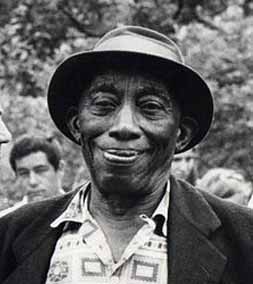
This may well be the first song I ever heard from Mississippi John Hurt, because it was his first track on the Blues at Newport LP from 1963. That was one of the defining albums for me, the first place I heard Dave Van Ronk, John Hammond, John Lee Hooker… I think I’d already heard Rev. Gary Davis, and I’m sure I’d heard Brownie McGhee and Sonny Terry, but their tracks on that LP are still the ones I recall most clearly.
The reason this one is showing up so late is that it took me many years to figure out how to play it. Hurt’s simpler arrangements were the bedrock of fingerstyle guitar, so I was playing “See, See Rider,” “My Creole Belle,” “Stagolee,” “Richlands Woman,” “Let the Mermaids Flirt with Me,” “Louis Collins,” “Got the Blues, Can’t Be Satisfied,” and other Hurt songs by my mid-teens, but I only learned “Candy Man” a decade or two later, and didn’t get it right until I began teaching at blues camps and had to figure out the weird E7 chord. (He was a supremely quirky and inventive player; it also took me years to figure out the timing of “Satisfied and Tickled Too.”)
In hindsight it’s a good thing I didn’t learn this at age ten or twelve, because it was inappropriate enough to be a little kid singing murder ballads, and I really didn’t need to be singing about having “a stick of candy nine inches long…”
Hurt had the reputation of being a sweet, gentle, almost saintly character, and a lot of people have suggested it was strange that he would sing something like this. Of course, it wasn’t the only erotic song in his repertoire: a rock group got it’s name from the “loving spoonful” chorus of his “Coffee Blues,” and in my post on his version of “Salty Dog” I suggest he probably had some verses for that song that he did not choose to record. That was normal for southern secular singers — Rev. Gary Davis also had a “Candy Man” song — and probably for any rural culture, since people with farm animals are aware from childhood about how they get more farm animals, even if they choose to reproduce more privately.
More recently I was struck by another aspect of this song, which is the suggestion of homoeroticism. The lyric is initially addressed to the ladies, but the warning that if you stand too close to the candy man he’ll “ease a stick of candy into your hand” hints at broader possibilities, as does the suggestion that if you try his candy, “good friend of mine,” you sure will want it for a long, long time.
In any case it’s a terrific guitar arrangement, and among the many things I love about John Hurt is his choice to sing this when he found himself performing for the first time in front of a bunch of callow white kids at Newport.
As for that E7 chord… You have to hold both the fourth and fifth strings on the second fret with your middle finger, so your ring finger can get the seventh on the second string, leaving your little finger free to get that high note on the fourth fret of the first string.
This is my favorite Joseph Spence piece to play — which is not the same as my favorite to hear. I love Spence’s singing, whether on his own or with his in-laws, the Pinder family, and if I had to take one Spence recording to the proverbial desert island it would more likely be a Bahamian anthem like “Out on the Rolling Sea.” But for playing… this is absolutely it.
For a while I thought this was an anomaly in Spence’s repertoire, because all the other selections on his Folkways album were gospel songs, but when I mentioned that to Dave Van Ronk, he said, “I assume he thought it was a gospel song.” Which, of course, is right — especially since it became a hit in 1943, during the American Federation of Musicians recording strike, so the most popular recording was an a cappella choral arrangement by the Song Spinners, plus versions by the Golden Gate Quartet and the Four Vagabonds.
Be that as it may, it was one of Spence’s favorites, which he extended with marvelous variations — not just improvisations on the standard A and B sections, but a two-chord interlude he added occasionally as a break. I always considered it his instrumental masterpiece, and only tackled it after working out a bunch of other pieces, some of which I’ve posted (“Brownskin Girl,” “Happy Meeting in Glory,” “Glory of Love,” “Sloop John B,” a medley of shorter tunes, and “Burma Road“) — and those posts also include my general recollections and thoughts about Spence, a front-runner for my all-time guitar hero.
The song itself was a World War II hit, with a dozen sheet music covers testifying to all the famous bands and singers who featured it, from Tommy Dorsey to Eddie Cantor, to Joe Venuti and the unrelated Benay Venuta. I was never enthralled by the lyrics and just enjoyed Spence’s guitar versions… until I was preparing this post and heard the Four Vagabonds’ version, which I’m going to my grave claiming was where he got it, just because.
This is Joseph Spence’s best-known guitar piece, and by the time I recorded my CD it had become a regular in my sets. At the time I thought I was pretty close to his sound, and I played a couple of my versions of his arrangements to Ernie Hawkins, and Ernie was kind enough to call Stefan Grossman and suggest that I would be a good person to do an instructional video on how to play Spence’s style. Stefan knew of me as a writer but had never heard me play, but he trusted Ernie and signed me up. So then I had to figure out how Spence actually played… and immediately realized I had most of it wrong.
That was frightening, but also exciting, because it forced me to engage with Spence’s recordings in a different way. Over the next few months I listened to them more closely than I’d ever listened to anything. In the past I had worked out reasonable versions of several of his pieces — this one, “Glory of Love,” and a much simplified “Brownskin Girl” — but I’d approached them one by one, as individual arrangements, rather than immersing myself in the way he thought and moved.
Now, I realized I needed to approach his music the way I would learn a language — not by memorizing sentences, but by learning how it fitted together as a whole system. Spence played everything in the same tuning and key (key of D, with the lowest string tuned down to D), using essentially the same chord shapes and techniques — the instrumental equivalent of a vocabulary and grammar. Techniques from one piece appeared in other pieces, and sometimes a voicing would be more obvious in a new piece, so as I learned more of his pieces I kept discovering things I’d misunderstood in other pieces… and although I never lost my accent, I eventually reached a basic level of fluency.
I also hunted up a couple of people who had watched Spence and played with him. Jody Stecher had recorded Spence and studied him closely, and was kind enough to let me come over to his place and play what I had, then correct some of my mistakes. But the real expert is Guy Droussart, who visited Spence for extended periods over many years.
I first tried to persuade Guy to do the video himself, since he was the obvious person, but he refused because he doesn’t like instructional videos. Guy thinks it is important to approach Spence directly and immerse oneself in his music and his world – not only the guitar style, but the Bahamian gospel vocal tradition, and also to develop the physical strength Spence had from a life as a stonemason, and the rhythm of the fishing boats. So he said no, and also declined to help me… but when I played my versions of some Spence pieces for him, he was horrified and pointed out particularly egregious errors, then told me how I should be fingering particular passages… and I listened and asked questions until he began feeling like he was getting too involved with the video project. So we’d end our conversation and I’d spend a few months assimilating his corrections, send him a tape of my current versions, and he’d still be horrified and would correct me some more… and it never got to a point where he was happy, but my playing certainly improved and I am infinitely grateful.
Eventually I felt comfortable enough with Spence’s language to make the video and this was one of the songs I taught. The way I play it now is a mix of choruses Spence played on his first recordings, made by Sam Charters for Folkways Records, with some more impromptu choruses using the same basic grammar and vocabulary.
On the Folkways LP this song was titled “Happy Meeting in Glory,” and I still tend to think of it that way, but its legal title is “That Great Reunion Day.” It was published in 1940 and composed by a gospel songwriter named Adger M. Pace. An online biography says he was born in South Carolina in 1882 and became the first president of the National Singing Convention, a teacher at the Vaughan School of Music in Lawrenceburg, Tennessee, and the bass singer for the Vaughan Radio Quartet on WOAN, one of the first radio stations in the South.
I always appreciated Blind Lemon Jefferson’s records, but didn’t attempt to learn his guitar style until shortly before recording my CD, Street Corner Cowboys — and then went through a crash course and ended up recording two of his songs, playing a bunch of others, and eventually teaching his style at a couple of blues camps.
Jefferson was the defining “down home blues” artist — quite literally, since as far as I can tell that phrase was first used in print to advertise his records. That was in 1926, when the blues record business was still dominated by women like Bessie Smith and Ida Cox. The only significant male artist was Lonnie Johnson, who had a smooth urban style like the blues queens — but a Dallas record store employee wrote to Paramount Records saying there was a street singer there who was very popular and suggesting they take a chance on him.
That was Jefferson, and I’m guessing the Paramount folks were dubious when they heard him. His guitar playing was quirky and idiosyncratic, with an odd, jerky rhythm, and his voice was a full-throated street corner shout. To everyone’s surprise, his records instantly took off, selling spectacularly to black consumers throughout the South and Midwest, and soon scouts were combing the South for other quirky street corner guitarists. The result was one of the richest periods of American recording, preserving the music of Blind Blake, Blind Willie McTell, Mississippi John Hurt, Jim Jackson, William Moore and myriad others… a world of astonishingly varied and creative musicians reaching from the Southwest to the Atlantic Coast. None of them equaled Jefferson’s sales figures, but they redefined blues as a rural style with guitar as its main instrument — an image that would fade on the African American market a few years later with the arrival of Leroy Carr, but remains central to folk-blues and blues-rock.
Getting back to my own experience… I learned a bunch of Jefferson’s pieces and it was a thrilling and liberating project. His guitar work was brilliant and opened up new possibilities in several keys, exercising my fingers and my mind, and I loved playing his stuff.
Nonetheless, over the next few years most of his songs drifted out of my repertoire. They were fun and interesting to play, but somehow never felt natural to me, and most of his arrangements were developed to fit his singing, which I couldn’t begin to match. So I went back to listening and admiring his work, and just kept a couple of his pieces in my repertoire: “Bad Luck Blues,” which I’ve used in this series as the accompaniment to “Keep It Clean,” and “Black Horse.”
“Black Horse Blues” was one of Jefferson’s first recordings and is unusual because the guitar part stands alone. Usually he played licks that followed or answered his voice, but for this one he created a quirky but thoroughly developed instrumental composition, full enough to serve both as accompaniment and an instrumental break . That meant I could learn it, then come up with a different way to sing the song rather than trying to imitate his vocals. It struck me that Jefferson was from Texas, and one of the things about his guitar playing, compared to players from further east, is that he sometimes relaxes into a kind of cowboy strumming — so I went with that, and sing in a cowboy-blues style, closer to someone like Woody Guthrie, who came from Oklahoma and grew up on Jefferson’s records.
The lyric is also interesting as an example of an American singer borrowing and reshaping an English ballad verse for blues performance. I noticed this when I was writing a chapter on blues poetry for my pocket guide for Oxford: The Blues: A Very Short Introduction. In the ballad of Gypsy Davy–which I first heard on one of Woody’s records–a woman runs off with a troupe of Gypsies and her husband follows her and tries to convince her to come home. Being a lord, he has servants, and when he finds his wife is gone he cries:
Go saddle me my old grey horse, the black one’s not so speedy. I’ll ride all day and I’ll ride all night, until I find my lady.”
Jefferson reworked those lines for his title verse:
Go get my black horse, saddle up my grey mare I’m going after my good gal, she’s in the world somewhere.
Another from Townes Van Zandt, though I don’t play his chords. I don’t remember why I changed them, or even if I was aware I had, and when I recently listened to his version I thought his were more interesting… But I’ve been playing it this way for a quarter century and it feels right to me.
As with all the Townes songs I do, I learned this off his Live at the Old Quarter double album from 1973 — it’s the pure, stripped down experience, and reminds me of what he was like live: dry, difficult, and magical. I’ve already written about my experiences of Townes over the years and my problems performing his songs in my post for “Waiting Round to Die.” The short version is I always loved his concerts and his writing, but most of the songs were so dark I couldn’t do them convincingly.
The exceptions were “Pancho and Lefty” — partly because I tended to do it as a duet with my pal Monte and partly because it’s pretty much foolproof — and this one.
To me, this is less a song than a modern saloon recitation in the tradition of classics like “The Face on the Barroom Floor,” T. Texas Tyler’s “Deck of Cards,” and Chuck Berry’s “Downbound Train.” It’s only marginally weirder, and similarly moralistic, and in its way it may be the most traditional thing Townes ever wrote.
Other than that, I don’t have much to say about it except that Townes was a terrific wordsmith and I love the way the lyric flows. And the way the card game anchors the fantasy. And the moral.
I heard this song all my life, but only started playing it when I recorded my CD, Street Corner Cowboys, in 2000. One of my sure-fire songs at that point was Dave Van Ronk’s arrangement of “Green Rocky Road,” but it seemed silly to record that since everyone knew Dave’s version… and then it struck me that I could do his version of “Old Blue” with pretty much the same arrangement. So I took a crack at it, liked it, and recorded it with Matt Leavenworth on mandolin and Paul Geremia on harmonica. I pretty much stuck with Dave’s lyrics, but when I tried to sing it like he did, with a sort of long moan on both lines of the chorus, it felt draggy, so I shortened the final line, and was thrilled when Paul said he’d never much liked the song, but that way it worked.
“Old Dog Blue” was first recorded in 1928 by the singer and guitarist Jim Jackson. Since he was recording in the blues era and had a huge hit with his first record, “Kansas City Blues,” Jackson is often called a blues singer, but he was a versatile all-around performer who had traveled with minstrel and medicine shows all over the South, then settled in Memphis working the clubs on Beale Street, and even held down a residency at the eminently fashionable Peabody Hotel. Checking back over his repertoire, I’m struck by how many songs I picked up from people who may well have got them from his records: the flip side of “Old Blue” was “He’s In the Jailhouse Now,” and he also cut versions of “Traveling Man” and “Hesitation Blues,” as well as such unique masterpieces as “I’m Gonna Start Me a Graveyard of My Own,” “I Heard the Voice of a Pork Chop,” and “Bye, Bye, Policeman.”
Samuel Charters, the blues scholar who roomed with Dave on MacDougal Street in the late 1950s, devoted several pages to Jackson in his groundbreaking The Country Blues and singled out this song for comment, saying that it was mentioned by Abbe Niles in The Bookman literary magazine: “…between articles on e.e. cummings and Virginia Woolf, there was a note about ‘Old Dog Blue… a wholly fascinating story of a hound who treed his possums anywhere he found them, from a holler stump to Noah’s Ark.'”
I figured Jackson was probably Dave’s source, though in the liner notes to his LP he said he couldn’t recall where he learned it and suggested the source might have been Guy Carawan. Back then I had no way to check and I’d forgotten about that note until today, when I went online to see if Carawan ever did it… and, by gum, he did. It’s a lovely performance, on a duet album with Peggy Seeger, and he sings a lot of the verses Dave sang, so apparently Dave’s memory was right. And, as it happens, he shortens that last line I was feeling so proud of shortening. So no credit to me, and I’m sorry Paul never heard Guy’s version.
Revisiting the songs that have made a home in my head

 I’d been aware of Guy Clark sort of tangentially for a long time, but tended to scratch my itch for Texas songwriters with Townes Van Zandt and Joe Ely (and, via Ely, Butch Hancock). Then Guy started coming through the Boston area regularly, and the first time I saw him I was blown away. As it turned out, almost all the songs that blew me away were from his first album, Old No1. Over the years I’ve learned half the songs on that record, and wouldn’t mind learning the other half, but as with Kris Kristofferson, I pretty much got stuck on the first album. Except…
 explained in
  Notre Dame in Paris, and the other of him as a kid in Brooklyn. But the designer who did the jacket had ideas of her own and decided to just use the Notre Dame shot… which she didn’t mention until after sending it to the printer… and although I managed to use it twenty years later in our book,
  showpieces. As explained in earlier posts, I shied away from most of Davis’s material because I was not interested in performing gospel songs, and for quite a while this was my favorite of his LPs — an opinion I later revised because he was such a spectacular singer, but by then I had practically memorized the first side of this album.

 G7 uses the classic Davis C7 shape, also favored by Dave Van Ronk and Jim Kweskin (and me), with the thumb wrapping two bass strings. (Now that I think of it, that D7 chord should also have the thumb wrapping two strings to get the root note in the bass.)
 owned, handed down from my half-brother Dave, and I never managed to learn anything from it. Some of his later books were very helpful, but I’m convinced that this kind of Delta blues doesn’t translate to the printed page — it’s all about the rhythm and feel, and knowing what notes someone is hitting doesn’t help much. Another thing that didn’t help was that at that point I hadn’t heard Willie Brown’s version, or House’s, or any of the various songs Patton sang with a similar arrangement, or Tommy Johnson’s “Maggie Campbell…”
 which were in the Grossman book. They were great, and I learned his “M&O Blues,” but I didn’t even attempt to learn this one. I was 16 years old, studying with Dave Van Ronk, and this style of guitar was too different from anything I knew how to play.
 House called this “The Jinx,” and he played it slower than Brown, at least when he was recording. As I recall, I started by learning his version, then mixed it with Brown’s. In any case, it turned out to be a conceptual breakthrough for me: Like a lot of white revival players, I always felt more comfortable with my blues guitar playing than my blues singing, and as a result I tended to work out a guitar part, then try to sing over it as best I could. That was particularly tricky on pieces like this, because of the way the rhythmic accents switch between on- and off-beats — but listening to House, it struck me that his guitar was following his singing. So rather than trying to perfect the guitar accents , I tried to concentrate on my singing and let the guitar follow… and to sing it like I was involved with the lyric rather than trying to sound like House or Brown… and suddenly everything felt right.
 I think I’d already heard Rev. Gary Davis, and I’m sure I’d heard Brownie McGhee and Sonny Terry, but their tracks on that LP are still the ones I recall most clearly.
 Hurt had the reputation of being a sweet, gentle, almost saintly character, and a lot of people have suggested it was strange that he would sing something like this. Of course, it wasn’t the only erotic song in his repertoire: a rock group got it’s name from the “loving spoonful” chorus of his “
 You have to hold both the fourth and fifth strings on the second fret with your middle finger, so your ring finger can get the seventh on the second string, leaving your little finger free to get that high note on the fourth fret of the first string.
 island it would more likely be a Bahamian anthem like “Out on the Rolling Sea.” But for playing… this is absolutely it.
 The song itself was a World War II hit, with a dozen sheet music covers testifying to all the famous bands and singers who featured it, from Tommy Dorsey to Eddie Cantor, to Joe Venuti and the unrelated Benay Venuta. I was never enthralled by the lyrics and just enjoyed Spence’s guitar versions… until I was preparing this post and heard the
  Stefan knew of me as a writer but had never heard me play, but he trusted Ernie and signed me up. So then I had to figure out how Spence actually played… and immediately realized I had most of it wrong.
 I first tried to persuade Guy to do the video himself, since he was the obvious person, but he refused because he doesn’t like instructional videos. Guy thinks it is important to approach Spence directly and immerse oneself in his music and his world – not only the guitar style, but the Bahamian gospel vocal tradition, and also to develop the physical strength Spence had from a life as a stonemason, and the rhythm of the fishing boats. So he said no, and also declined to help me… but when I played my versions of some Spence pieces for him, he was horrified and pointed out particularly egregious errors, then told me how I should be fingering particular passages… and I listened and asked questions until he began feeling like he was getting too involved with the video project. So we’d end our conversation and I’d spend a few months assimilating his corrections, send him a tape of my current versions, and he’d still be horrified and would correct me some
  more… and it never got to a point where he was happy, but my playing certainly improved and I am infinitely grateful.
 songwriter named Adger M. Pace. An online biography says he was born in South Carolina in 1882 and became the first president of the National Singing Convention, a teacher at the Vaughan School of Music in Lawrenceburg, Tennessee, and the bass singer for the Vaughan Radio Quartet on WOAN, one of the first radio stations in the South.
 Jefferson was the defining “down home blues” artist — quite literally, since as far as I can tell that phrase was first used in print to advertise his records. That was in 1926, when the blues record business was still dominated by women like
 That meant I could learn it, then come up with a different way to sing the song rather than trying to imitate his vocals. It struck me that Jefferson was from Texas, and one of the things about his guitar playing, compared to players from further east, is that he sometimes relaxes into a kind of cowboy strumming — so I went with that, and sing in a cowboy-blues style, closer to someone like
  when I was writing a chapter on blues poetry for my pocket guide for Oxford: The Blues: A Very Short Introduction. In the ballad of Gypsy Davy–which I first heard on one of Woody’s records–a woman runs off with a troupe of Gypsies and her husband follows her and tries to convince her to come home. Being a lord, he has servants, and when he finds his wife is gone he cries:
 As with all the Townes songs I do, I learned this off his Live at the Old Quarter double album from 1973 — it’s the pure, stripped down experience, and reminds me of what he was like live: dry, difficult, and magical. I’ve already written about my experiences of Townes over the years and my problems performing his songs in my post for “
 To me, this is less a song than a modern saloon recitation in the tradition of classics like “The Face on the Barroom Floor,” T. Texas Tyler’s “Deck of Cards,” and Chuck Berry’s “Downbound Train.” It’s only marginally weirder, and similarly moralistic, and in its way it may be the most traditional thing Townes ever wrote.
 Dave’s version… and then it struck me that I could do his version of “Old Blue” with pretty much the same arrangement. So I took a crack at it, liked it, and recorded it with Matt Leavenworth on mandolin and Paul Geremia on harmonica. I pretty much stuck with Dave’s lyrics, but when I tried to sing it like he did, with a sort of long moan on both lines of the chorus, it felt draggy, so I shortened the final line, and was thrilled when Paul said he’d never much liked the song, but that way it worked.
 Memphis working the clubs on Beale Street, and even held down a residency at the eminently fashionable Peabody Hotel. Checking back over his repertoire, I’m struck by how many songs I picked up from people who may well have got them from his records: the flip side of “Old Blue” was “
 Carawan. Back then I had no way to check and I’d forgotten about that note until today, when I went online to see if Carawan ever did it… and, by gum, he did. It’s